
Agastyakula Gāyatrī Tantra Rahasya
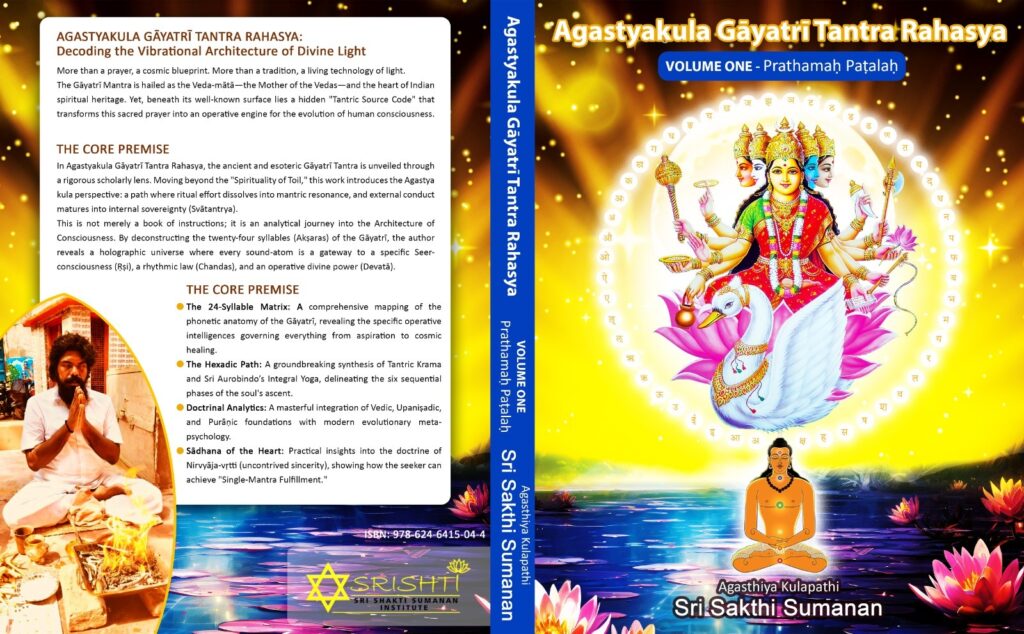
The Gāyatrī Mantra is among the most widely known and recited sacred formulas in the world. Yet, beyond its familiarity lies a profound inner science—one that few encounter in its original depth and structure.
Get Your Copy via WhatsAppAgastyakula Gāyatrī Tantra Rahasya – Volume One invites the reader into this deeper dimension.
Rooted in the Gāyatrī Tantra, a sacred revelation preserved within the Devī Bhāgavata Purāṇa, this book unveils the mantra not merely as a prayer or devotional chant, but as a precise architecture of consciousness—a living system through which awareness awakens, evolves, integrates, and heals.
Unlike popular presentations that treat Gāyatrī as a single undifferentiated sound, the Tantra reveals its twenty-four syllables as a graded inner journey. Each akṣara is shown to be governed by a Ṛṣi (seer-mode of perception), a Chandas (rhythmic law of movement), and a Devatā (operative divine intelligence). Together, these form a complete map of inner transformation embedded directly within sound itself.
This first volume focuses entirely on the Prathamaḥ Paṭalaḥ (First Chapter) of the Gāyatrī Tantra—a deliberate choice. Rather than beginning with ritual or technique, the Tantra opens by revealing the inner grammar of the mantra, establishing a foundational doctrine that governs all later practice. In seed form, this chapter contains the entire logic of Gāyatrī sādhana: aspiration, illumination, power, embodiment, integration, and final stabilization.
Written by Śrī Śakthi Sumanan
A lineage-holder of the Agastya Siddha tradition and a lifelong practitioner of Gāyatrī upāsanā, this work brings together:
- rigorous Sanskrit and Tantric scholarship,
- Purāṇic and Vedic cross-references,
- Siddha and Śākta interpretive depth, and
- insights drawn from more than three decades of lived sādhana.
Each śloka is presented with accurate Sanskrit text, IAST transliteration, word-by-word meaning, integrated translation, and multi-layered commentary—bridging textual fidelity with inner understanding. The analysis moves beyond ritual instruction to illuminate why the mantra works, how sound functions as consciousness, and what transformation truly means in a Tantric context.
This book does not promise quick results or sensational experiences. Instead, it restores the seriousness, compassion, and precision with which the Gāyatrī Mantra was originally transmitted—offering clarity to scholars, orientation to sādhakas, and depth to seekers who sense that this mantra is far more than words.
If this book enables even a few readers to approach the Gāyatrī Mantra not simply as something to be recited, but as something to be entered, its purpose will have been fulfilled.