
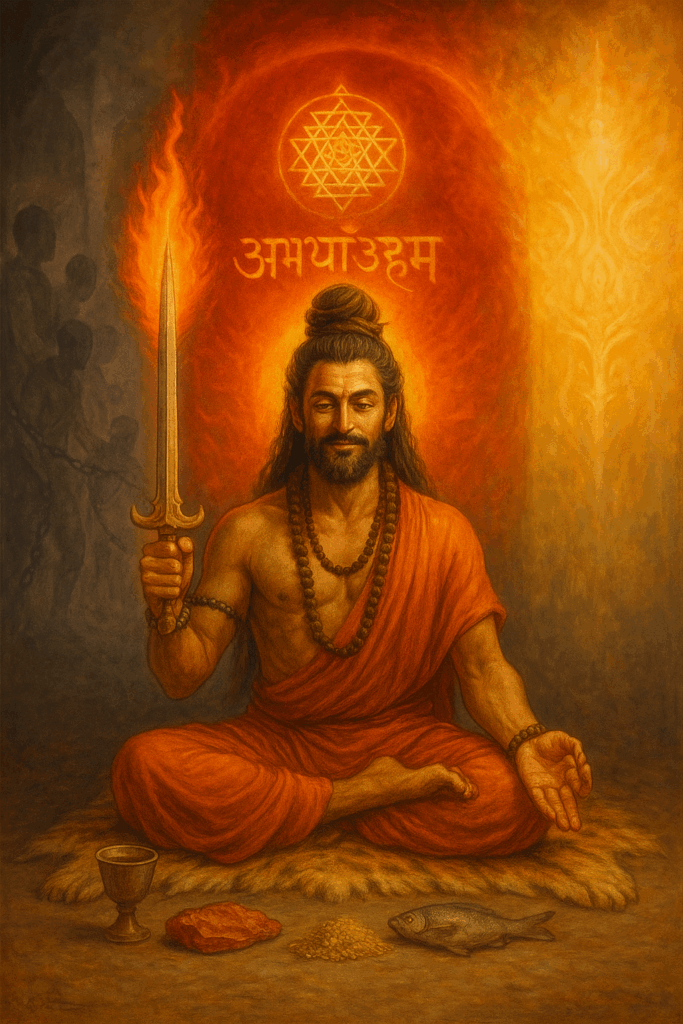
🕉️ Vīra Bhāva in Tantra Śāstra
1️⃣ Definition and Overview
Vīra Bhāva (वीरभाव) literally means the heroic disposition or the courageous attitude.
It refers to a spiritual temperament distinguished by:
- Fearlessness (abhaya)
- Non-attachment to rigid social conventions
- Capacity to engage transgressive or “forbidden” practices as a means to transcend duality
- A powerful, self-reliant spiritual enthusiasm
In the Tantric classification, all practitioners are grouped into three bhāvas:
- Pāśu Bhāva – the bound and timid attitude
- Vīra Bhāva – the heroic and transformative attitude
- Divya Bhāva – the divine and naturally liberated attitude
This classification is most systematically taught in the Kularṇava Tantra (esp. Chapters 2, 8, and 9).
2️⃣ Scriptural References
📜 Kularṇava Tantra (Chapter 2, Verse 15)
पाशवो ये भवेन्मर्त्ये, वीराश्च दिव्य एव च।
pāśavo ye bhaven martyāḥ vīrāś ca divya eva ca
“Among mortals, some are Pāśu, some are Vīra, and some are Divya.”
This sets the framework that Vīra Bhāva is a middle, transformative state—the soul no longer bound by fear (Pāśu), yet not fully merged in divine awareness (Divya).
3️⃣ Characteristics of Vīra Bhāva
🔹 1. Fearlessness (Abhaya)
Vīra is undaunted by criticism, social taboo, or danger.
He knows the real enemy is ignorance (avidyā), not social judgment.
Kularṇava Tantra 2.16
“He is called Vīra who, abandoning fear, worships with a mind purified by knowledge.”
🔹 2. Transcendence of Duality
The Vīra understands that purity and impurity are relative concepts within Māyā.
Therefore, Vīra Bhāva permits ritual practices involving “forbidden” substances—such as wine, meat, sexual union—not for indulgence, but as a means to break attachment and recognize non-dual Śiva-consciousness.
Mahanirvana Tantra 8.52
“By rejecting all distinction between pure and impure, the Vīra attains liberation.”
🔹 3. Commitment to Guru and Sādhana
While independent in spirit, the Vīra is deeply devoted to the Guru’s word and the practice of mantra, nyāsa, and meditation.
Kularṇava Tantra 9.35
“He who is steady in the Guru’s command, who does not tremble in any circumstance—that adept is called Vīra.”
🔹 4. Capacity for “Left-Hand” (Vāmācāra) Sādhanā
In Vīra Bhāva, the practitioner is authorized (by initiation) to practice Pañca-Makāra Sādhanā (“the Five Ms”):
- Madya – wine
- Māṃsa – meat
- Matsya – fish
- Mudrā – grain or gesture
- Maithuna – ritual union
These are symbolic and often internalized, but when practiced externally, it requires Vīra Bhāva to overcome social fear and cultivate non-dual awareness.
Kaulajñānanirṇaya 11.44
“Without the Vīra Bhāva, the practitioner becomes bound; with Vīra Bhāva, the same acts become liberating.”
🔹 5. Equanimity in All States
Vīra remains unmoved in honor or dishonor, gain or loss, joy or suffering.
Kularṇava Tantra 2.20
“Equanimous in praise and blame, that man is a true Vīra.”
4️⃣ The Symbolism of the Vīra
- The Vīra is called Kula-Vīra (the hero of the Kaula lineage).
- He is compared to a lion among sheep—undaunted, free, noble.
- His defining mark is inner sovereignty (svātantrya).
5️⃣ Cautions About Misunderstanding Vīra Bhāva
Tantra texts warn that without initiation, scriptural guidance, and inner readiness, attempting Vīra practices leads to spiritual ruin and further bondage.
Kularṇava Tantra 9.43
“He who, lacking understanding and initiation, imitates the acts of the Vīra, falls into hell.”
True Vīra Bhāva is an inner state of wisdom and detachment—not mere outer ritual.
6️⃣ Difference from Pāśu and Divya Bhāva
| Aspect | Pāśu Bhāva | Vīra Bhāva | Divya Bhāva |
|---|---|---|---|
| Temperament | Fearful, bound by convention | Courageous, transcends taboo | Naturally pure, effortless |
| View of Purity | Attached to dualities of pure/impure | Transcends all dualities | Abides spontaneously in non-duality |
| Sādhanā | Outer ritual, worship of devatā | Vīra sādhanā, Pañca-Makāra, internal realization | Direct awareness of Self as Śiva |
| Goal | Merit, purification | Liberation through courage and knowledge | Spontaneous liberation |
7️⃣ In Summary
✅ Vīra Bhāva is:
- The heroic inner attitude of the tantric practitioner.
- Marked by fearlessness, detachment, and transgressive wisdom.
- A transformative state between bondage (Pāśu) and divinity (Divya).
✅ It requires:
- Proper initiation (Dīkṣā)
- Guidance of the Guru
- Disciplined sādhana
- Inner purification
Without these, imitating Vīra Bhāva is considered a grave spiritual error.
✨ Key Scriptural References
- Kularṇava Tantra, Chapters 2, 8, 9
- Mahanirvana Tantra, Chapters 8–10
- Kaulajñānanirṇaya of Matsyendranātha