
Author name: Sri Shakthi Sumanan

The Synthesis of Yoga by Sri Aurobindo – Part I – The Yoga of Divine Works Chapter One Summary – “The Four Aids” simplified summary

🌟 Part I – The Yoga of Divine Works

Chapter One Summary – “The Four Aids” (Simplified)

Sri Aurobindo now begins the practical explanation of his Integral Yoga. In this first chapter of Part I, he introduces the four essential helps that support the seeker on their spiritual path.


🧭 What Are the Four Aids?

Sri Aurobindo explains that the journey of Yoga is not taken alone. The seeker is supported by four powerful aids:


1️⃣ Shastra – Spiritual Knowledge and Teachings

  • “Shastra” means scripture or body of wisdom.
  • These are teachings and writings that guide the seeker—like the Gita, the Upanishads, or the writings of realized sages.
  • They help us understand the goal, the methods, and the dangers of the path.
  • But they are not mechanical rules. The seeker must apply them wisely and intuitively.

📘 “The Shastra is a help, not a cage.”


2️⃣ Utsāha – Personal Effort and Aspiration

  • “Utsāha” means enthusiasm, energy, and effort.
  • The seeker must take responsibility: be sincere, disciplined, and willing to grow.
  • Without effort, knowledge remains theory.
  • But this effort must not be ego-driven—it should be offered to the Divine.

⚠️ Self-effort alone is not enough, but it is essential as a starting point.


3️⃣ Guru – The Divine Guide or Teacher

  • The Guru is the one who awakens the Divine Consciousness in the seeker.
  • The true Guru is not just a person, but a channel of the Divine, often acting from within as the “Inner Teacher.”
  • The external Guru is helpful, but ultimately the Divine is the real Master.

👣 “He who chooses the Divine has already been chosen by the Divine.”


4️⃣ Kāl – Time and the Divine Working

  • “Kāl” means Time.
  • The process of transformation takes time. Rushing or forcing results is not the way of the Divine.
  • The Divine works silently and surely. Trust in the divine timing is key.
  • One must be patient, persistent, and open.

⏳ “Nothing in the path is wasted; all effort ripens when the time is ripe.”


🧩 How Do These Four Work Together?

  • The Shastra shows the road.
  • Utsāha gives the will to walk it.
  • The Guru protects and awakens the traveler.
  • Time and the Divine Force carry the traveler to the destination.

All four must unite for the Yoga to move steadily forward.


💡 Key Message:

“The path of Yoga is guided by knowledge, effort, guidance, and divine timing.”
We do not walk alone. With the right aspiration, help from the Guru, trust in Time, and wisdom from the Shastra, the journey becomes possible for all.
The Synthesis of Yoga by Sri Aurobindo – Part I – The Yoga of Divine Works Chapter One Summary – “The Four Aids” simplified summary Read More »

The Synthesis of Yoga by Sri Aurobindo – Chapter Five Summary – “The Synthesis of the Systems” simplified summary

🌱 Chapter Five Summary – “The Synthesis of the Systems” (Simplified)

After describing the traditional Yogas (Karma, Jnana, Bhakti), Sri Aurobindo now explains how to unite them into a complete or Integral Yoga that embraces all parts of life and human nature.


⚙️ Why a Synthesis Is Needed

  • Each Yoga path touches a vital part of the being:
    • Karma → Will and action
    • Jnana → Mind and knowledge
    • Bhakti → Heart and emotion
  • But used alone, each is partial.
  • The full transformation of human nature needs all powers—heart, mind, will, body—united under the Divine.

“Yoga must not only liberate the soul but transform the whole life into its divine possibility.”


🧠💓✋ What Happens When the Yogas Combine?

When the three are practiced together:

  • Knowledge (Jnana) gives understanding of the Divine.
  • Love (Bhakti) gives emotional union and surrender.
  • Works (Karma) give practical realization through daily life.

Together, they:

  • Uplift every part of the being.
  • Remove ego at all levels.
  • Make the Divine not just a truth beyond life, but a living Presence within life.

🔁 Their True Meeting Point: The Divine Itself

  • The real synthesis isn’t a mental “combination.”
  • It happens naturally when all parts of the being turn toward the one central truth—the Divine.
  • The Divine becomes the:
    • Goal of knowledge,
    • Beloved of the heart,
    • Master of the work.

“Not three separate paths, but three faces of one movement toward the Divine.”


🧘‍♂️🌍 This Synthesis Has a Purpose: Transforming Earth-Life

  • Traditional Yogas aim at liberation from life.
  • Sri Aurobindo’s Integral Yoga aims at transformation of life.
  • That’s why it needs to:
    • Embrace the body (physical Yoga),
    • Enter cosmic consciousness (universal Yoga),
    • Receive the Supramental (divine truth-consciousness).

🧭 A New Kind of Yoga for a New Age

  • We are in a time of spiritual evolution.
  • Just as matter gave rise to life, and life to mind, so now mind must give way to spirit.
  • This requires a Yoga not of escape, but of perfection—of human nature shaped into divine nature.

“This is not a Yoga for the few, but for the future.”


💡 Key Message:

“Yoga is the passage from the human to the divine.”
By synthesizing the great Yogas—action, knowledge, devotion—we begin a new step in evolution: not liberation from the world, but manifestation of the Divine in the world.

The Synthesis of Yoga by Sri Aurobindo – Chapter Five Summary – “The Synthesis of the Systems” simplified summary Read More »

The Synthesis of Yoga by Sri Aurobindo – Chapter Four Summary – “The Systems of Yoga” simplified summary

🌱 Chapter Four Summary – “The Systems of Yoga” (Simplified)

In this chapter, Sri Aurobindo explains the traditional paths of Yoga—how they each focus on a specific part of our being—and why a greater synthesis is needed for full spiritual transformation.


🧘‍♂️ The Main Traditional Yogas

1️⃣ Karma Yoga – The Path of Action

  • This path focuses on selfless work, dedicating all actions to the Divine.
  • The aim is to surrender the ego, become an instrument of the Divine Will.
  • It purifies the will and dynamic nature.

“Do the work, but offer all to the Divine—not for personal gain or desire.”

2️⃣ Jnana Yoga – The Path of Knowledge

  • This path is for those who seek the highest truth through inner reflection and discrimination.
  • The seeker tries to go beyond the mind to discover the One Self or Brahman, the silent, formless Reality.
  • It purifies the intellect and brings inner detachment.

“You are not the body, not the mind—you are the pure Self.”

3️⃣ Bhakti Yoga – The Path of Devotion

  • This is the path of the heart, of intense love and surrender to the Divine.
  • The seeker relates to the Divine as a lover, child, servant, or friend.
  • It purifies the emotions and awakens divine joy.

“Give your heart entirely to the Divine—let love lead the way.”


🧩 Each Yoga Works on One Part of Us

  • Karma Yoga works on the will.
  • Jnana Yoga works on the mind.
  • Bhakti Yoga works on the heart.

But each leaves out other parts, or doesn’t transform them fully.


❗ Limits of Separate Systems

  • These separate paths can lead to liberation or some form of inner realization.
  • However, they may neglect other vital parts of our being:
    • For example, Jnana may ignore emotions or body.
    • Bhakti may leave behind the thinking mind.
  • Therefore, they do not lead to complete transformation of life.

⚠️ Traditional Yoga often aims at escape from life, not transformation of life.


🔄 Why a New Synthesis Is Needed

Sri Aurobindo says:

  • We must go beyond these limited systems.
  • The true goal is to transform the whole being—body, mind, heart, will—into the Divine image.
  • This needs an integral approach, combining all powers of our nature in a harmonious way.

💡 Key Message:

“No part of our being should be left untouched by the Yoga.”
We need a Yoga that doesn’t leave out life, body, or world. It must take all of us—action, thought, emotion—and offer everything to the Divine for transformation.

The Synthesis of Yoga by Sri Aurobindo – Chapter Four Summary – “The Systems of Yoga” simplified summary Read More »

The Synthesis of Yoga by Sri Aurobindo – Chapter Three Summary – “The Threefold Life” simplified summary

🌱 Chapter Three Summary – “The Threefold Life” (Simplified)

In this chapter, Sri Aurobindo speaks about three kinds of life that humanity experiences and how Yoga seeks to bring a higher harmony among them.


1️⃣ The Material Life (The First Life)

  • This is the life of the body, senses, desires, and outer needs.
  • Most people live at this level: working to satisfy physical wants, pursue pleasures, avoid pain, and survive.
  • It is rooted in the external world and driven by instincts, emotions, and ambitions.

⚠️ It is full of restlessness, suffering, and limitation.
Alone, it cannot give true happiness or fulfillment.


2️⃣ The Mental or Intellectual Life (The Second Life)

  • This is the life of the thinker, artist, idealist, moralist, philosopher—those who seek deeper truths, beauty, justice, and purpose.
  • It is an effort to rise above the chaos and selfishness of the material world.
  • But it is detached, often avoiding action and life’s messiness to protect its purity.

⚠️ Although noble, it lacks full power and often withdraws from the real world.


3️⃣ The Spiritual or Divine Life (The Third Life)

  • This is the life of the soul turned to the Divine, the highest truth, and inner reality.
  • It seeks union with God, not only in quietness and meditation but in all life.
  • True Yoga begins here: not by escaping the world, but by transforming life itself into a divine expression.

🌟 This is the future of humanity—a divine life on earth, where body, mind, and spirit are united in truth and harmony.


⚖️ Why Is There Conflict?

  • Often, these three lives pull in different directions:
    • The material seeks comfort and power.
    • The mental seeks truth and ideals.
    • The spiritual seeks inner union and peace.
  • But these must not be enemies. The true goal is to integrate them.

🛤 The Solution: Integral Yoga

Sri Aurobindo proposes a synthesis:

  • Purify and uplift the material life.
  • Enlighten and widen the mental life.
  • Center everything in the divine spiritual consciousness.

Yoga must not leave life behind—it must bring divine perfection into life.


💡 Key Message:

“To transfigure the whole of life into a divine harmony is the true aim.”
The threefold life must not be divided or escaped from. Instead, they should be joined in oneness, led by the Divine, so that the human being may become a conscious expression of the divine in the world.

The Synthesis of Yoga by Sri Aurobindo – Chapter Three Summary – “The Threefold Life” simplified summary Read More »

The Synthesis of Yoga by Sri Aurobindo – Chapter Two: “The Three Steps of Nature” simplified summary

🌱 Chapter Two Summary – “The Three Steps of Nature” (Simplified)

Sri Aurobindo explains how Nature evolves life through three clear steps:


1️⃣ Step One: What Is Already Evolved – The Body and Life-Energy

  • Nature has already successfully built the physical body (made of matter) and the life-energy (prāṇa or vital force).
  • This base is essential. Even our thinking and spiritual seeking happen inside this body.
  • Sri Aurobindo says: Matter is not to be despised—it is the foundation of all that we do.

⚠️ Escaping the body or life is not the true goal of Yoga.
Instead, divinizing the body and vital energy is part of spiritual perfection.


2️⃣ Step Two: What Is Still Evolving – The Mind

  • Mind is the current focus of evolution. It’s not yet perfect or fully developed in most people.
  • Even among humans, true mental living—guided by pure reason, self-mastery, and freedom—is still rare.
  • The mind is evolving from being tied to the body and desires, toward freedom, knowledge, and higher consciousness.

🧠 Humanity’s next leap lies in training the intellectual and spiritual mind to go beyond ordinary thinking.


3️⃣ Step Three: What Is Yet to Be Fully Evolved – The Divine or Spiritual Mind

  • Beyond the mental intellect lies the divine mind, often referred to as the Supramental or higher spiritual consciousness.
  • This level already exists in rare souls (like great sages), but it has not become common in humanity.
  • This divine plane is what Yoga tries to bring into the body, life, and mind.

🌟 The divine potential is there within us—but hidden.
Through Yoga, we consciously unveil it and evolve beyond our current limitations.


🧭 What This Means for Yoga

  • Yoga must embrace all three steps: respect the body, master the mind, and awaken the spiritual self.
  • The goal is not to reject life, but to uplift all levels—body, life, and mind—into their divine possibilities.

⚠️ The great error is to treat the physical body or life-force as an enemy.
The right way is to purify, transform, and include them in spiritual growth.


💡 Key Message:

“The spiritual transformation must complete what Nature has begun.”
The true Yoga is integral—not escaping life, but completing evolution by awakening the divine in all parts of being.

The Synthesis of Yoga by Sri Aurobindo – Chapter Two: “The Three Steps of Nature” simplified summary Read More »

The Synthesis of Yoga by Sri Aurobindo in a simplified form – Chapter One: “Life and Yoga”

🌱 Chapter One Summary – “Life and Yoga” (Simplified)

1. Nature’s Two Great Movements:
Sri Aurobindo begins by observing two truths about how Nature works:

  • Every system or way of life begins as a whole, then breaks into parts (specialized methods), and later seeks to reunite in a richer, more powerful synthesis.
  • No method, idea, or truth stays permanently fresh unless it is constantly renewed with the living spirit. Otherwise, it becomes outdated.

2. Yoga Must Constantly Be Reborn:
Yoga, though ancient and deeply powerful, is going through this same process. It has many forms and schools, but now it must find a new self-discovery and unity to become useful for the modern world.

3. What Is Yoga?

  • Yoga is a systematic effort to perfect oneself, by expressing hidden potentials within and ultimately uniting with the Divine Existence—the universal and transcendent Reality that underlies everything.
  • All life, consciously or unconsciously, is a kind of Yoga. Even Nature’s slow evolution is an unconscious Yoga towards perfection.

📌 Swami Vivekananda said: Yoga is a way to compress evolution into a single life.

4. Yogic Effort is Nature’s Work Done Intensely:
Yoga isn’t unnatural or strange. It is Nature’s own process done faster and more consciously. Just like science brings out electricity hidden in Nature, Yoga brings out hidden powers of consciousness.

5. Different Yogas – Same Goal:
Each path of Yoga (like Hatha, Raja, Bhakti, Jnana) uses different parts of our being—body, will, heart, intellect—to reach the Divine. But all are based on truths already present in Nature.

6. Dangers of Over-Focusing on Technique:
Just like over-reliance on technology can reduce human spontaneity, too much focus on Yogic technique may separate a seeker from the richness of life.

7. The Common Mistake – Escaping Life:
Many spiritual seekers believe they must abandon the world and life to reach the Divine. But Sri Aurobindo warns:

This is not the full truth. The true aim is to unite God and Life, spirit and nature, in a transformed human existence.

8. Real Yoga Embraces Life:
The final goal of Yoga is not escape from life, but transformation of it—bringing divine consciousness into ordinary human living.


💡 Key Message:

All life is Yoga.”
Even our ordinary experiences are steps in the soul’s journey to unite with the Divine. The task is not to escape the world, but to uplift it with spiritual light.

The Synthesis of Yoga by Sri Aurobindo in a simplified form – Chapter One: “Life and Yoga” Read More »

What is Sādhana?

What is Sādhana?

Sādhana is the easiest, most beautiful, and most natural method of attaining perfection, i.e., God-realization (bhagavat-prāpti).
That which brings about our full physical, mental, and spiritual evolution — is called sādhana.

  • When the body becomes healthy, strong, and capable,
  • When the mind is filled with knowledge, love, and bliss,
  • When we see all beings as living manifestations of our beloved Divine and become actively engaged in the welfare of all
    that is the goal of sādhana.

If the distorted perceptions people hold about sādhana are corrected, we believe that even non-believers and atheists will be drawn to the practice of sādhana–bhajana.
Who does not desire a healthy body and a joyous mind?

To understand the divine law (bhagavad-vidhāna) and live in accordance with it, to thereby gain progress and fulfillment in life — this is the purpose of sādhana and devotion (bhajana).

Those who strive for progress and peace, even if unknowingly, are practicing sādhana. If they became aware of the principles of sādhana, they would understand how to attain supreme progress and highest peace through the most natural and graceful means.

With the help of scripture (śāstra), guru, and discriminative wisdom (viveka), we must inquire:

  • What is the true purpose of my life?
  • Why have I come here?
  • What is the highest fulfillment of my life?
  • And by what means can I attain perfection and supreme peace?

The wise have carefully examined and realized that wealth, relatives, pleasures, and prosperity provide only temporary happiness, not lasting fulfillment. Such joys cannot quench the natural thirst of the heart.

The sages have demonstrated through direct experience that the supreme goal of life is the realization of God (bhagavat-prāpti).

To attain God is to attain perfection — or supreme peace.

Thus, to align all actions of our body, mind, and soul with the goal of God-realization and complete fulfillment — this is our sādhana.

With the help of true knowledge and the guidance of the wise, we must:

  • Understand this supreme principle (parama-tattva),
  • Learn the means to attain it, and
  • Apply it in our life through right action, so as to attain supreme peace and thereby fulfill the true purpose of life.

What is Sādhana? Read More »

Kāla Jñāna: The Sacred Knowledge of Time

By the Grace of the Guru, and the Wisdom of the Siddhas


Introduction

Time (Kāla) is one of the most mysterious and powerful forces in existence. Every human being, at some point, wonders about their future, seeks clarity about their present, or wishes to transcend the limitations of the past. In the realm of Tantra and ancient Indian wisdom, there exists a deeply esoteric discipline known as Kāla Jñāna—the Knowledge of Time.

Far beyond mere astrology or fortune-telling, Kāla Jñāna is a living science. It is the intuitive ability to perceive the hidden flow of events, to read nature’s signals, and to align oneself with the rhythm of the cosmos. This knowledge, when practiced with purity and dedication, leads the seeker not only to mastery over time but ultimately toward Self-realization.


Time: A Conscious Force

Kāla is not just a measure of hours or days—it is a conscious principle. It reveals itself to those who are aware, disciplined, and spiritually attuned. When a seeker begins this journey, they start recognizing that nature constantly speaks. The rustling of leaves, the direction of the wind, the behavior of birds—all of these are subtle indicators of unfolding events.

The practitioner of Kāla Jñāna learns to decode this symbolic language. This is not superstition, but a deeply refined form of inner perception—a siddhi born of stillness, silence, and sacred mantra.


The Role of the Guru

The path of Kāla Jñāna is not to be undertaken alone. It is never learned from books. It is a sacred science passed only through a qualified Guru, who has himself attained this knowledge through rigorous sādhana. The Guru initiates the disciple through dīkṣā, gradually awakening the dormant faculties that lie beyond the senses.

Without the Guru’s grace, this wisdom remains inaccessible. With it, the sādhaka slowly becomes a trikāla-jñānī—a knower of past, present, and future.


The Mantra of Kāla Jñāna

At the heart of this knowledge lies a sacred mantra—the Kāla Jñāna Mantra. This mantra is no ordinary formula. It is kept secret, only revealed to a deserving practitioner after they have demonstrated self-restraint, humility, and spiritual maturity.

Reciting this mantra at the right time, using precise ritual methods, opens the inner door to Time’s essence. The practitioner begins to perceive what is about to happen and develops the capacity to respond with clarity and strength.

This mantra is not just a set of syllables. It is a key of consciousness that unlocks the higher states of awareness where Time becomes visible.


The Practice and Discipline

Kāla Jñāna is not a gift of chance—it is earned through severe personal discipline. The practitioner must purify:

  • Ahāra (Diet)
  • Nidrā (Sleep)
  • Vichāra (Thoughts)
  • Vyavahāra (Conduct)

Through meditation (dhyāna), mantra repetition (japa), and gazing techniques (trāṭaka), the sādhaka gradually withdraws from worldly noise and attunes to inner silence. In that inner stillness, the signs of Time begin to appear.

What once seemed like random events are now seen as orchestrated patterns. Decision-making becomes effortless, guided by the wisdom of Kāla itself.


From Knowledge to Mastery

As the practitioner deepens their awareness, they begin to sense other people’s timelines as well. They can intuit the destiny, crisis, or opportunities coming in someone’s life without asking any questions.

This is not magic. It is the flowering of an expanded, refined consciousness—sūkṣma caitanya—born of sincere tapas (austerity).

Eventually, the seeker becomes fearless, having transcended the dread of the unknown. For when one knows what is coming, and how to meet it, fear dissolves.


Becoming the Master of Time

The culmination of Kāla Jñāna is not just prediction, but freedom. The practitioner no longer remains a servant of Time, but its master. Their actions become precise. Their words carry power. Their life becomes purposeful, vibrant, and aligned with divine rhythm.

Every moment becomes a conscious act of sādhanā. Every breath, a step closer to the Self.

And in this final realization, they do not merely know Time—they come to know themselves.


Conclusion: A Call to the Seeker

Kāla Jñāna is not just a mystical concept. It is a transformative path. If you are sincere, if your heart is pure, and your mind resolved, this knowledge can transform your life.

The Guru lights the way.
The mantra opens the door.
And your sādhana carries you through it.

May those who are ready, take this path with humility and determination.
And in time, may they come to master Time itself.

Kāla Jñāna: The Sacred Knowledge of Time Read More »

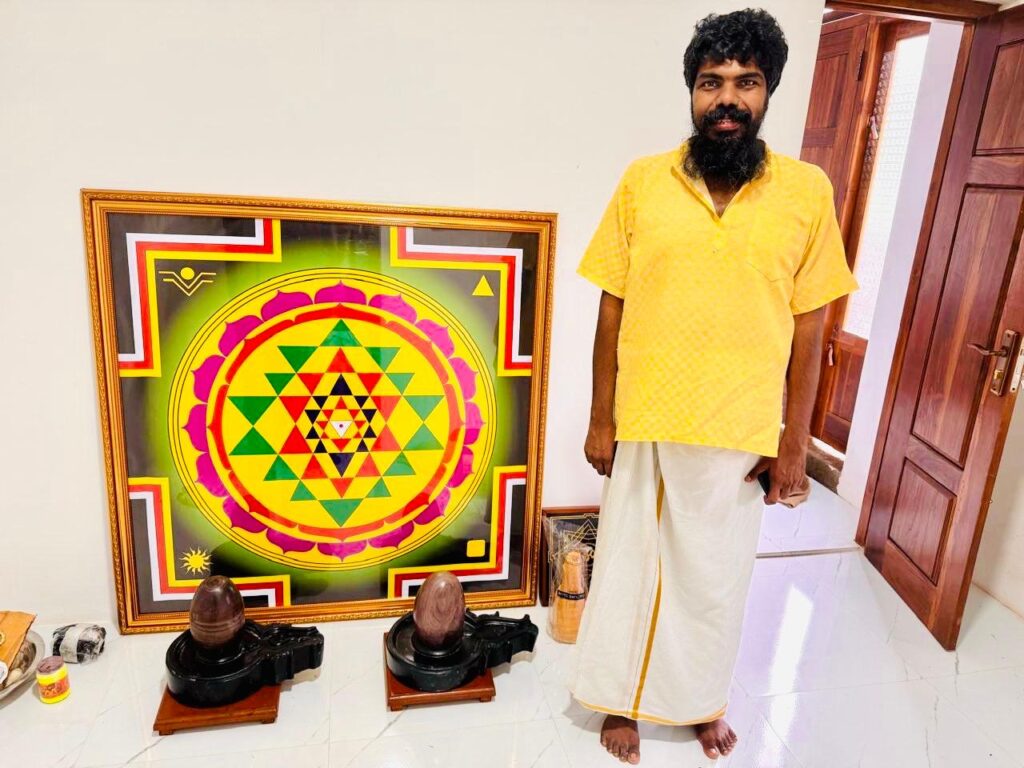
Tejorāja Śrīśakti Bāṇa Liṅga Mounadeva Tapomūrti Liṅga

Today is an exceptionally auspicious day known as Śrīhari Parva, aligned with the divine aṣṭāṅga (eightfold) path of the Goddess. As per the promise given by our revered Guru Nātha this morning, selected liṅgas were brought from the correct āvuṭai (sacred place) at the proper hour. Through a full maṇḍala (mandalic cycle) of tapas (austerity), they were then carried with tireless devotion to be consecrated today under this auspicious muhūrta.

Rudrābhiṣekam was performed at the sanctum of Agatthīśvara in Kāśī, another Rudrābhiṣekam was conducted at the Aricchandra cremation ground, followed by Kālabhairava Pūjā, and finally, a Saptaṛṣi Pūjā to Viśvanātha. These sacred actions were made possible only through the full blessings of the Guru Maṇḍala and the unwavering dedication of the initiated disciples.

Our heartfelt love and blessings go to all the students who undertook and fulfilled this sacred task. In ancient times, at Mūthūr by the banks of the great Mahāvali Gaṅgā in Lanka, Sage Agastya once established a Gurukulam and initiated Śivaliṅga Pratiṣṭhā (consecration of Śiva liṅgas).

Now, the next divine cycle shall begin by the banks of the White River!

May the Light of Agastya shine throughout the world. ❤

Tejorāja Śrīśakti Bāṇa Liṅga Mounadeva Tapomūrti Liṅga Read More »

Understanding Buddhi, Ahaṁkāra, and Manas through the Logic of Guṇas

The chart (based on your description and context) illustrates the Samkhya philosophical model of how Prakṛti’s three guṇasSattva, Rajas, and Tamas—combine in various intensities to form the first evolutes of manifest creation when consciousness (Puruṣa) comes into proximity with matter (Prakṛti). Here’s a detailed breakdown of the logic and argument behind the table:


🟡 Core Philosophical Framework:

  • Prakṛti (Nature): The unmanifest, primal matter composed of the three guṇas.
  • Puruṣa (Consciousness): The eternal, passive witness and knower—pure awareness.
  • Guṇas (Constituents):
    • Sattva – light, clarity, knowledge
    • Rajas – activity, motion, passion
    • Tamas – inertia, obscuration, dullness

🧠 Table Logic: The Evolution of Subtle Matter

The table shows how the dominance of different guṇas leads to the formation of different evolutes (first forms) of the mind-stuff (chitta):

EvoluteSattvaRajasTamasDominant Guṇa
Buddhi (Intellect)321Sattva
Ahaṁkāra (Ego)132Rajas
Manas (Mind)213Tamas
  • The score of 3 indicates the dominant guṇa in the respective component.
  • The values show the proportional influence of each guṇa.
  • Each evolute forms a part of chitta, or mind-stuff, in subtle matter (sūkṣma-prakṛti).
  • These are not yet gross elements (like earth, water) but the subtle mental faculties through which Puruṣa interacts with the world.

Philosophical Implication:

  • These three evolutes together form the antahkaraṇa (inner instrument):
    • Buddhi allows discrimination and decision-making.
    • Ahaṁkāra gives the sense of “I” or individuality.
    • Manas organizes sensory inputs and facilitates mental processing.

Once these subtle evolutes are infused with Puruṣa’s light (conscious awareness), they become instruments of knowing, even though they themselves are unconscious by nature (as products of Prakṛti).


🧩 Argument Summary:

  • Prakṛti alone cannot evolve without the presence of Puruṣa.
  • Once Puruṣa is present, Prakṛti’s guṇas shift from equilibrium and evolve into complex layers of reality.
  • The first layer is subtle and mental, not physical.
  • The combination of guṇas determines the nature of the evolution:
    • More Sattva → intellect
    • More Rajas → ego
    • More Tamas → mind

🔎 Deeper Insight:

This model offers a metaphysical psychology: our thoughts, ego, and intellect are not random—they are structured evolutions of matter influenced by specific qualities of nature and illumined by spirit.

Understanding Buddhi, Ahaṁkāra, and Manas through the Logic of Guṇas Read More »

You cannot copy content of this page