Uncategorized

The Synthesis of Yoga by Sri Aurobindo – Chapter Three Summary – “The Threefold Life” simplified summary

🌱 Chapter Three Summary – “The Threefold Life” (Simplified)

In this chapter, Sri Aurobindo speaks about three kinds of life that humanity experiences and how Yoga seeks to bring a higher harmony among them.


1️⃣ The Material Life (The First Life)

  • This is the life of the body, senses, desires, and outer needs.
  • Most people live at this level: working to satisfy physical wants, pursue pleasures, avoid pain, and survive.
  • It is rooted in the external world and driven by instincts, emotions, and ambitions.

⚠️ It is full of restlessness, suffering, and limitation.
Alone, it cannot give true happiness or fulfillment.


2️⃣ The Mental or Intellectual Life (The Second Life)

  • This is the life of the thinker, artist, idealist, moralist, philosopher—those who seek deeper truths, beauty, justice, and purpose.
  • It is an effort to rise above the chaos and selfishness of the material world.
  • But it is detached, often avoiding action and life’s messiness to protect its purity.

⚠️ Although noble, it lacks full power and often withdraws from the real world.


3️⃣ The Spiritual or Divine Life (The Third Life)

  • This is the life of the soul turned to the Divine, the highest truth, and inner reality.
  • It seeks union with God, not only in quietness and meditation but in all life.
  • True Yoga begins here: not by escaping the world, but by transforming life itself into a divine expression.

🌟 This is the future of humanity—a divine life on earth, where body, mind, and spirit are united in truth and harmony.


⚖️ Why Is There Conflict?

  • Often, these three lives pull in different directions:
    • The material seeks comfort and power.
    • The mental seeks truth and ideals.
    • The spiritual seeks inner union and peace.
  • But these must not be enemies. The true goal is to integrate them.

🛤 The Solution: Integral Yoga

Sri Aurobindo proposes a synthesis:

  • Purify and uplift the material life.
  • Enlighten and widen the mental life.
  • Center everything in the divine spiritual consciousness.

Yoga must not leave life behind—it must bring divine perfection into life.


💡 Key Message:

“To transfigure the whole of life into a divine harmony is the true aim.”
The threefold life must not be divided or escaped from. Instead, they should be joined in oneness, led by the Divine, so that the human being may become a conscious expression of the divine in the world.

The Synthesis of Yoga by Sri Aurobindo – Chapter Three Summary – “The Threefold Life” simplified summary Read More »

The Synthesis of Yoga by Sri Aurobindo in a simplified form – Chapter One: “Life and Yoga”

🌱 Chapter One Summary – “Life and Yoga” (Simplified)

1. Nature’s Two Great Movements:
Sri Aurobindo begins by observing two truths about how Nature works:

  • Every system or way of life begins as a whole, then breaks into parts (specialized methods), and later seeks to reunite in a richer, more powerful synthesis.
  • No method, idea, or truth stays permanently fresh unless it is constantly renewed with the living spirit. Otherwise, it becomes outdated.

2. Yoga Must Constantly Be Reborn:
Yoga, though ancient and deeply powerful, is going through this same process. It has many forms and schools, but now it must find a new self-discovery and unity to become useful for the modern world.

3. What Is Yoga?

  • Yoga is a systematic effort to perfect oneself, by expressing hidden potentials within and ultimately uniting with the Divine Existence—the universal and transcendent Reality that underlies everything.
  • All life, consciously or unconsciously, is a kind of Yoga. Even Nature’s slow evolution is an unconscious Yoga towards perfection.

📌 Swami Vivekananda said: Yoga is a way to compress evolution into a single life.

4. Yogic Effort is Nature’s Work Done Intensely:
Yoga isn’t unnatural or strange. It is Nature’s own process done faster and more consciously. Just like science brings out electricity hidden in Nature, Yoga brings out hidden powers of consciousness.

5. Different Yogas – Same Goal:
Each path of Yoga (like Hatha, Raja, Bhakti, Jnana) uses different parts of our being—body, will, heart, intellect—to reach the Divine. But all are based on truths already present in Nature.

6. Dangers of Over-Focusing on Technique:
Just like over-reliance on technology can reduce human spontaneity, too much focus on Yogic technique may separate a seeker from the richness of life.

7. The Common Mistake – Escaping Life:
Many spiritual seekers believe they must abandon the world and life to reach the Divine. But Sri Aurobindo warns:

This is not the full truth. The true aim is to unite God and Life, spirit and nature, in a transformed human existence.

8. Real Yoga Embraces Life:
The final goal of Yoga is not escape from life, but transformation of it—bringing divine consciousness into ordinary human living.


💡 Key Message:

All life is Yoga.”
Even our ordinary experiences are steps in the soul’s journey to unite with the Divine. The task is not to escape the world, but to uplift it with spiritual light.

The Synthesis of Yoga by Sri Aurobindo in a simplified form – Chapter One: “Life and Yoga” Read More »

What is Sādhana?

What is Sādhana?

Sādhana is the easiest, most beautiful, and most natural method of attaining perfection, i.e., God-realization (bhagavat-prāpti).
That which brings about our full physical, mental, and spiritual evolution — is called sādhana.

  • When the body becomes healthy, strong, and capable,
  • When the mind is filled with knowledge, love, and bliss,
  • When we see all beings as living manifestations of our beloved Divine and become actively engaged in the welfare of all
    that is the goal of sādhana.

If the distorted perceptions people hold about sādhana are corrected, we believe that even non-believers and atheists will be drawn to the practice of sādhana–bhajana.
Who does not desire a healthy body and a joyous mind?

To understand the divine law (bhagavad-vidhāna) and live in accordance with it, to thereby gain progress and fulfillment in life — this is the purpose of sādhana and devotion (bhajana).

Those who strive for progress and peace, even if unknowingly, are practicing sādhana. If they became aware of the principles of sādhana, they would understand how to attain supreme progress and highest peace through the most natural and graceful means.

With the help of scripture (śāstra), guru, and discriminative wisdom (viveka), we must inquire:

  • What is the true purpose of my life?
  • Why have I come here?
  • What is the highest fulfillment of my life?
  • And by what means can I attain perfection and supreme peace?

The wise have carefully examined and realized that wealth, relatives, pleasures, and prosperity provide only temporary happiness, not lasting fulfillment. Such joys cannot quench the natural thirst of the heart.

The sages have demonstrated through direct experience that the supreme goal of life is the realization of God (bhagavat-prāpti).

To attain God is to attain perfection — or supreme peace.

Thus, to align all actions of our body, mind, and soul with the goal of God-realization and complete fulfillment — this is our sādhana.

With the help of true knowledge and the guidance of the wise, we must:

  • Understand this supreme principle (parama-tattva),
  • Learn the means to attain it, and
  • Apply it in our life through right action, so as to attain supreme peace and thereby fulfill the true purpose of life.

What is Sādhana? Read More »

Kāla Jñāna: The Sacred Knowledge of Time

By the Grace of the Guru, and the Wisdom of the Siddhas


Introduction

Time (Kāla) is one of the most mysterious and powerful forces in existence. Every human being, at some point, wonders about their future, seeks clarity about their present, or wishes to transcend the limitations of the past. In the realm of Tantra and ancient Indian wisdom, there exists a deeply esoteric discipline known as Kāla Jñāna—the Knowledge of Time.

Far beyond mere astrology or fortune-telling, Kāla Jñāna is a living science. It is the intuitive ability to perceive the hidden flow of events, to read nature’s signals, and to align oneself with the rhythm of the cosmos. This knowledge, when practiced with purity and dedication, leads the seeker not only to mastery over time but ultimately toward Self-realization.


Time: A Conscious Force

Kāla is not just a measure of hours or days—it is a conscious principle. It reveals itself to those who are aware, disciplined, and spiritually attuned. When a seeker begins this journey, they start recognizing that nature constantly speaks. The rustling of leaves, the direction of the wind, the behavior of birds—all of these are subtle indicators of unfolding events.

The practitioner of Kāla Jñāna learns to decode this symbolic language. This is not superstition, but a deeply refined form of inner perception—a siddhi born of stillness, silence, and sacred mantra.


The Role of the Guru

The path of Kāla Jñāna is not to be undertaken alone. It is never learned from books. It is a sacred science passed only through a qualified Guru, who has himself attained this knowledge through rigorous sādhana. The Guru initiates the disciple through dīkṣā, gradually awakening the dormant faculties that lie beyond the senses.

Without the Guru’s grace, this wisdom remains inaccessible. With it, the sādhaka slowly becomes a trikāla-jñānī—a knower of past, present, and future.


The Mantra of Kāla Jñāna

At the heart of this knowledge lies a sacred mantra—the Kāla Jñāna Mantra. This mantra is no ordinary formula. It is kept secret, only revealed to a deserving practitioner after they have demonstrated self-restraint, humility, and spiritual maturity.

Reciting this mantra at the right time, using precise ritual methods, opens the inner door to Time’s essence. The practitioner begins to perceive what is about to happen and develops the capacity to respond with clarity and strength.

This mantra is not just a set of syllables. It is a key of consciousness that unlocks the higher states of awareness where Time becomes visible.


The Practice and Discipline

Kāla Jñāna is not a gift of chance—it is earned through severe personal discipline. The practitioner must purify:

  • Ahāra (Diet)
  • Nidrā (Sleep)
  • Vichāra (Thoughts)
  • Vyavahāra (Conduct)

Through meditation (dhyāna), mantra repetition (japa), and gazing techniques (trāṭaka), the sādhaka gradually withdraws from worldly noise and attunes to inner silence. In that inner stillness, the signs of Time begin to appear.

What once seemed like random events are now seen as orchestrated patterns. Decision-making becomes effortless, guided by the wisdom of Kāla itself.


From Knowledge to Mastery

As the practitioner deepens their awareness, they begin to sense other people’s timelines as well. They can intuit the destiny, crisis, or opportunities coming in someone’s life without asking any questions.

This is not magic. It is the flowering of an expanded, refined consciousness—sūkṣma caitanya—born of sincere tapas (austerity).

Eventually, the seeker becomes fearless, having transcended the dread of the unknown. For when one knows what is coming, and how to meet it, fear dissolves.


Becoming the Master of Time

The culmination of Kāla Jñāna is not just prediction, but freedom. The practitioner no longer remains a servant of Time, but its master. Their actions become precise. Their words carry power. Their life becomes purposeful, vibrant, and aligned with divine rhythm.

Every moment becomes a conscious act of sādhanā. Every breath, a step closer to the Self.

And in this final realization, they do not merely know Time—they come to know themselves.


Conclusion: A Call to the Seeker

Kāla Jñāna is not just a mystical concept. It is a transformative path. If you are sincere, if your heart is pure, and your mind resolved, this knowledge can transform your life.

The Guru lights the way.
The mantra opens the door.
And your sādhana carries you through it.

May those who are ready, take this path with humility and determination.
And in time, may they come to master Time itself.

Kāla Jñāna: The Sacred Knowledge of Time Read More »

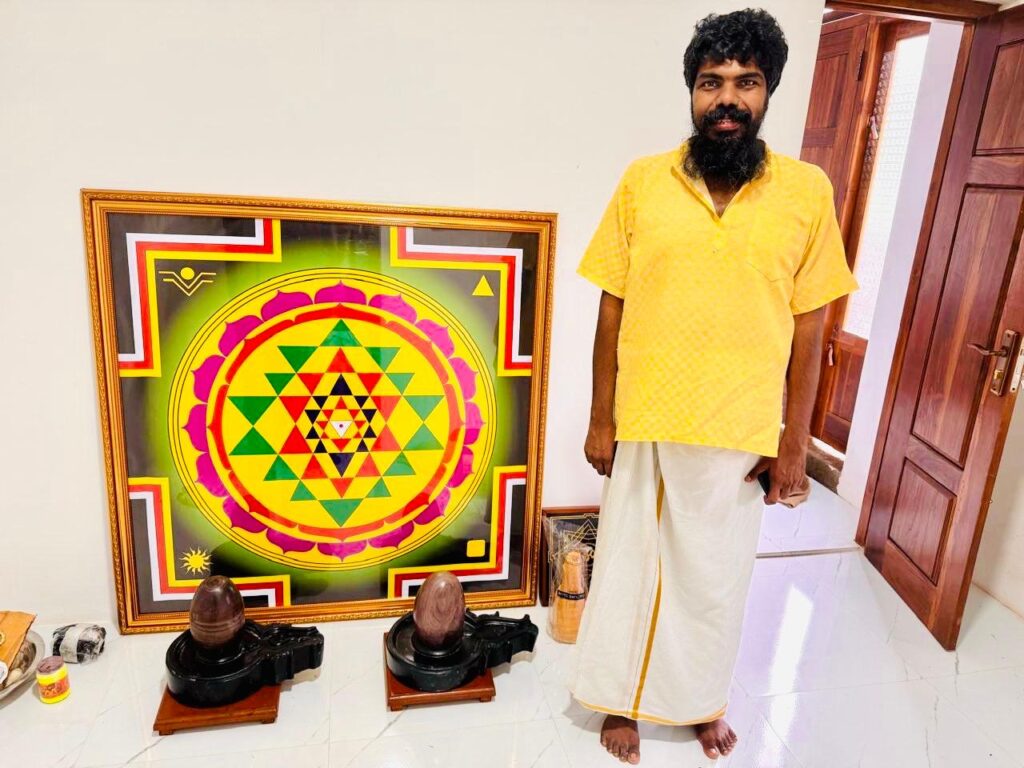
Tejorāja Śrīśakti Bāṇa Liṅga Mounadeva Tapomūrti Liṅga

Today is an exceptionally auspicious day known as Śrīhari Parva, aligned with the divine aṣṭāṅga (eightfold) path of the Goddess. As per the promise given by our revered Guru Nātha this morning, selected liṅgas were brought from the correct āvuṭai (sacred place) at the proper hour. Through a full maṇḍala (mandalic cycle) of tapas (austerity), they were then carried with tireless devotion to be consecrated today under this auspicious muhūrta.

Rudrābhiṣekam was performed at the sanctum of Agatthīśvara in Kāśī, another Rudrābhiṣekam was conducted at the Aricchandra cremation ground, followed by Kālabhairava Pūjā, and finally, a Saptaṛṣi Pūjā to Viśvanātha. These sacred actions were made possible only through the full blessings of the Guru Maṇḍala and the unwavering dedication of the initiated disciples.

Our heartfelt love and blessings go to all the students who undertook and fulfilled this sacred task. In ancient times, at Mūthūr by the banks of the great Mahāvali Gaṅgā in Lanka, Sage Agastya once established a Gurukulam and initiated Śivaliṅga Pratiṣṭhā (consecration of Śiva liṅgas).

Now, the next divine cycle shall begin by the banks of the White River!

May the Light of Agastya shine throughout the world. ❤

Tejorāja Śrīśakti Bāṇa Liṅga Mounadeva Tapomūrti Liṅga Read More »

Failure to Maintain Regular Sādhanā

  1. We are all part of a guru lineage that guides us on the path of attaining jñāna while actively engaging in worldly life and performing our karmas.
  2. This is not an easy path. Within the 24 hours given to us each day, we must perform our duties and fulfill our family responsibilities. To overcome the challenges of this life, we must gain strength through uninterrupted practice of sādhanā.
  3. For those with high personal expectations or who desire immediate results, this path may bring confusion and frustration.
  4. However, for those who are willing to accept reality and walk this path with understanding and sincerity, it becomes a simple and direct way.
  5. If you feel intense sorrow or guilt when your sādhanā is disrupted, it indicates the presence of ego or attachment—the belief that “I am the one doing this.” Such a mindset only creates unnecessary inferiority complex and suffering.
  6. If you abandon your sādhanā and believe that “My Guru will take care of everything,” or “Only if the Goddess grants her grace will I be able to practice,” then know that you are caught in ignorance and tamas (inertia).
  7. When we perform sādhanā along with the consequences of karma and daily responsibilities, obstacles are natural. The correct attitude is to restart the practice immediately, without dwelling on the reason for the interruption or trying to find excuses. Any reasoning or justification is to be avoided.
  8. Initially, one must practice continuously for 45 days without compromise to build the discipline of regular sādhanā.
  9. Regardless of external circumstances, one must carry a small version of the practice—a shortened form (e.g., chanting each mantra 27 times)—that can be performed during travel, or any other situation.
  10. Even during times when one hasn’t bathed, is traveling, or is in a state of ritual impurity, this brief protocol should be followed so that one affirms inwardly, “I have not abandoned my sādhanā.” However, such shortened practices should not be counted in the formal japa tally. Only when you perform the full practice as per your accepted sankalpa (e.g., 108 repetitions daily), should it be recorded in your japa count.

Failure to Maintain Regular Sādhanā Read More »

Gāyatrī Mahāvijñāna -22

No Fear of Harm in These Practices

The practice of mantras follows a specific discipline and methodology. To attain success, one must perform daily recitations, prescribed rituals, anushṭhāna (intensive spiritual discipline), and purashcaraṇa (repetitive chanting with austerities) with proper adherence to the rules. In general, an improperly conducted ritual may prove harmful to the practitioner, and instead of yielding benefits, it might bring unfavorable consequences.

There are numerous instances where an individual engaged in mantra sādhana, worship of deities, yogic exercises, or tāntrika rituals—but due to mistakes in methodology, or interruption in the practice, the practitioner had to face severe misfortunes. Such examples are found in historical and scriptural accounts.

For instance, in the Vedic legend of Vṛtra and Indra, mispronunciation of Vedic mantras led to disastrous consequences. The same applies to all Vedic mantras, including Gāyatrī, which should be chanted correctly with precise phonetics and proper intonation. A methodically performed anushṭhāna yields swift success and excellent results.

However, unlike other mantras, Gāyatrī has a unique safeguardit never causes harm, even if mistakes are made in its practice.

Just as a compassionate and wise mother always seeks the well-being of her children, Veda-Mātā (the Divine Mother Gāyatrī) ensures the spiritual progress of her devotees. A child might unknowingly offend or err in honoring its mother, yet the mother never harbors resentment or inflicts harm. Even when children act contrary to her wishes, she forgives them with boundless compassion.

If an ordinary mother exhibits such immense mercy and patience, how much more merciful would Veda-Mātā, the divine embodiment of wisdom and virtue, be towards her devotees?

The moment she sees sincere faith and devotion in a devotee’s heart, her grace overflows, and any minor mistakes or ritualistic errors dissolve like a straw swept away in the current of her divine compassion.


Bhagavad Gītā’s Assurance of Fearlessness in Righteous Practice

Lord Kṛṣṇa assures in the Bhagavad Gītā (2.40):

“Ne’hābhikrama-nāśo’sti pratyavāyo na vidyate,
svalpam apyasya dharmasya trāyate mahato bhayāt.”

📖 Translation:
“In this righteous endeavor, there is no loss of effort nor any adverse reaction. Even a small step taken on this path protects one from great fears.”

This verse emphasizes that any effort made towards a righteous act (satkarma) never goes in vain. Even if one’s practice is interrupted, it does not yield negative consequences. The benefits of spiritual effort continue accumulating and protect the seeker from great dangers.

Similarly, Gāyatrī Sādhana is a pure and sattvic (virtuous) spiritual pursuit. Once initiated, it naturally attracts the mind towards it. Even if a practitioner discontinues the practice for some reason, the urge to resume it arises again and again—just as a person who has once tasted a delicious nectar craves it repeatedly.

Gāyatrī Sādhana is like spiritual nourishment, which the soul constantly yearns for. If errors occur in practice, they do not result in harm. The only possible outcome of mistakes could be:

  1. A reduced level of benefit, or
  2. At worst, no effect at all.

There is no risk of calamity, disaster, or negative consequences.

Even the smallest sincere effort in this path yields immense benefits and grants freedom from fears that might otherwise be difficult to overcome.


Nārada’s Inquiry and Lord Nārāyaṇa’s Response in Bhāgavata Purāṇa

In the twelfth canto of the Bhāgavata Purāṇa, Nārada Muni once asked Lord Nārāyaṇa:

“Please reveal a method that even ordinary beings can practice with ease and that would ensure divine grace for their welfare.”

Nārada’s concern was valid—most spiritual disciplines require strict rules, renunciation, and intense penance, making them difficult for the common person to follow.

📖 Lord Nārāyaṇa replied:

“O Nārada! Even if a person does not perform other rituals, if they have unwavering faith in Gāyatrī, they make their life blessed. Those who offer libations (arghya) at sunrise and sunset and recite Gāyatrī 3,000 times daily become worthy of worship even by the gods.”

The scriptures state:

“Devo bhūtvā devaṁ yajet”
(One must elevate themselves to a divine state before worshiping the divine.)

However, if someone cannot perform the detailed ritualistic observances, but instead meditates on the divine essence of Gāyatrī with a pure heart, that too is sufficient for immense spiritual progress.

📌 Even mastering just one syllable of the Gāyatrī mantra can elevate a devotee to a state where they attain divine stature, comparable to Viṣṇu, Śiva, Brahmā, Sūrya, Candra, and Agni.

📌 A disciplined Gāyatrī practitioner attains all spiritual perfections (siddhis) through this single mantra. There is no doubt about this truth.

📌 Thus, in this age, Gāyatrī Sādhana—being the purest and most selfless practice—is the highest spiritual pursuit.


Practicing Gāyatrī Sādhana Without Fear

With these reflections, Gāyatrī seekers should discard all fears and doubts and practice fearlessly, with devotion.

Gāyatrī is not an ordinary mystical weapon that requires elaborate technicalities for activation. Instead, she is like a loving mother—one does not need cunning methods to approach her; a child simply calls ‘Mother!’ with sincerity, and she comes running.

A calf does not need to use tricks to find its mother—it simply calls out, and the mother cow responds with love and feeds it abundantly.

📌 Similarly, all that is required to invoke Gāyatrī’s grace is a sincere heart and unwavering faith.

📌 We must strive to follow the scriptural guidelines to the best of our ability. However, just as a mother forgives her child’s innocent mistakes, Veda-Mātā forgives minor errors in practice—so long as the devotion and sincerity are genuine.

📌 One must never abandon Gāyatrī Sādhana due to fear of making mistakes.
📌 Even an imperfect effort in her worship is infinitely better than neglecting it altogether.


Conclusion: Embracing Gāyatrī Without Hesitation

  • The Divine Mother Gāyatrī does not punish her children for unintentional mistakes.
  • Unlike certain esoteric practices that can backfire if done incorrectly, Gāyatrī only brings blessings.
  • One should approach her with faith and devotion, not with fear or doubt.

Thus, let us call upon Veda-Mātā with pure hearts, absorb her divine nectar, and embrace the boundless grace she showers upon her sincere devotees.


Gāyatrī Mahāvijñāna -22 Read More »

Gāyatrī Mahāvijñāna – 21

The Philosophy of Selfless Sādhana

Whether Gāyatrī Sādhana is performed selflessly (niṣkāma bhāva) or with desire (sakāma bhāva), it inevitably yields results. Just as food, whether consumed with desire or indifference, still nourishes the body, quenches hunger, and generates blood, similarly, the practice of Gāyatrī always leads to some outcome. The Bhagavad Gītā and other sacred scriptures emphasize selfless action (niṣkāma karma) because even when a righteous act is performed with utmost diligence, it does not always guarantee the desired outcome.

Often, we observe that even after careful execution of a task, the intended goal is not achieved. This can lead a practitioner to become disheartened, doubtful, or indifferent towards their spiritual path. To prevent such disillusionment, the scriptures have extolled selfless action and regarded it as superior to desire-driven efforts.

This does not mean that the effort put into sādhana is wasted or that the practice itself is unreliable. There is absolutely no room for doubt regarding its authenticity or efficacy. Not even a single moment spent in this endeavor goes to waste. Everyone who has walked this path has reaped immense benefits. However, it is not always guaranteed that one will attain exactly what they desire.

The reason lies in karma and destiny (prārabdha). When past karmic imprints (prārabdha) ripen and manifest as predetermined destiny, they cannot be easily altered. Some karmic influences are malleable and can be modified through effort and spiritual practices, while others are fixed and unavoidable. Even great beings have had to endure their unshakable prārabdha and undergo suffering despite their immense merits.

For instance:

  • Rāma’s exile,
  • Sītā’s abandonment,
  • Kṛṣṇa’s departure from the world after being struck by a hunter’s arrow,
  • King Harishchandra’s sacrifice, where he had to sell even his wife and son,
  • King Nala’s separation from Damayantī,
  • The Pāṇḍavas’ struggles and their ultimate renunciation in the Himalayas,
  • The great archer Prithvīrāja Chauhān being imprisoned and killed by foreign invaders.

📌 Why did such exalted figures endure such adversities?
At the same time, we see instances where insignificant and powerless individuals suddenly attain immense wealth and prosperity. These paradoxical occurrences can only be explained by the immutable force of prārabdha (destined karma).

The Role of Effort Amidst Predestined Karma

One might then question: “If destiny is unchangeable, what is the use of effort?”

It is crucial to understand that not all aspects of life are governed by prārabdha. Only certain preordained events are unavoidable, but most of life’s circumstances are influenced by present actions.

In general, effort leads to immediate results, and we witness the direct correlation between action and outcome in most cases. However, rarely, exceptions occur—wherein good efforts yield bad results or bad actions bring success. Diligent and intelligent individuals sometimes struggle, while lazy and foolish ones find undeserved fortune.

But such exceptions do not form the general rule. If these reversals were the norm, the entire system of karma would collapse, and humanity would either resort to unethical shortcuts or resign themselves to fate, leading to total disorder.

📌 Thus, such deviations are occasional anomalies, not universal principles.
📌 Gāyatrī Sādhana, when performed with desire (sakāma), usually brings success, but sometimes, predetermined karma may obstruct its effects.
📌 When an aspirant does not obtain the expected result, it should be understood that prārabdha’s influence is dominant at that time.

No Effort in Gāyatrī Sādhana Goes to Waste

Even if one’s desired outcome is not attained, the spiritual effort is never in vain.

Consider a young wrestler who trains rigorously, consuming nutritious food and exercising regularly, to defeat a competitor. If, despite all preparation, he loses the match, his training is not wasted. He still gains:

  • A stronger physique
  • Improved stamina
  • A radiant countenance
  • Greater endurance
  • Overall health benefits
  • Longevity and vitality

Even though he may not have won the specific match, the strength and fitness he gained will continue to benefit him throughout life.

📌 Similarly, even if a practitioner does not attain a specific wish through Gāyatrī Sādhana, they gain immense spiritual and mental benefits.
📌 One who sincerely performs Gāyatrī Sādhana can never remain empty-handed.

The Divine Perspective on Desire and Fulfillment

At times, our desires may seem beneficial to us, but from the divine perspective, they may not be appropriate. Just as a child demands harmful objects, a patient may crave unhealthy food, but their mother or physician denies them for their own well-being, similarly, the Divine grants only what is truly necessary and beneficial.

  • A wise mother does not indulge all of her child’s wishes.
  • A doctor does not give every requested medicine to a patient.
  • Similarly, God, who is all-knowing, grants only what is best for us.

Many Gāyatrī practitioners may possess the mindset of children or patients—they firmly believe their desires are valid, but in reality, they may be asking for something detrimental. If a Gāyatrī Sādhaka does not receive their desired outcome, it could be because their wish was short-sighted or inappropriate for their spiritual growth.

A mother gives one child sweets and toys, while another she takes for painful surgery. The child undergoing the surgery may see it as cruelty, but the mother knows she is acting out of love.

📌 Likewise, our misfortunes, struggles, and hardships may often be divine interventions for our ultimate well-being.
📌 Through suffering, the Divine removes hidden afflictions and prepares us for a better future.

The True Essence of Selfless (Niṣkāma) Sādhana

Thus, even if Gāyatrī Sādhana does not yield immediate results, one must not lose faith or patience. Those who surrender to the Divine with trust will never be forsaken.

📌 Selfless sādhana (niṣkāma sādhanā) is as rewarding as desire-driven sādhana (sakāma sādhanā).
📌 The Divine Mother (Gāyatrī) is fully aware of her children’s needs and does not let them remain deprived of what is truly essential.

The best approach is to practice Gāyatrī Sādhana without attachment to results, and observe how the Divine Intelligence unfolds blessings in every aspect of life.

Those who surrender fully to Gāyatrī experience an invisible divine protection and never lack what they truly need.

Final Truth:

📌 No Gāyatrī Sādhana ever goes to waste.

Gāyatrī Mahāvijñāna – 21 Read More »

Gāyatrī Mahāvijñāna -20

The Purpose of Gāyatrī Sādhana

New thoughts replace old ones. If a person misunderstands something incorrectly, they can be guided towards the right understanding through reasoning, evidence, and examples. Unless the individual is extremely corrupt, ignorant, agitated, or blinded by arrogance, grasping the truth does not pose significant difficulty. Once the truth is understood, erroneous beliefs naturally change. Even if someone continues to defend their previous beliefs due to self-interest or a desire to uphold their prestige, their perspective and convictions are inevitably transformed. Dispelling ignorance through knowledge is not particularly challenging.

However, this does not hold true for one’s nature, inclinations, desires, emotions, and inherent tendencies—these cannot be easily altered through conventional means. Once deeply ingrained, they do not relinquish their hold easily. Since a human being passes through 8.4 million lower life forms before taking birth in a human body, it is natural that their deeply embedded animalistic tendencies from past births remain firmly rooted in their psyche. These tendencies undergo gradual transformation, but true change occurs only when one contemplates deeply and distinguishes between good and evil, righteousness and unrighteousness. A person can clearly recognize their own faults, vices, and weaknesses. At the intellectual level, they wish to rid themselves of these shortcomings, and at times, they even severely criticize themselves. Yet, despite such awareness, they fail to free themselves from their deeply ingrained negative tendencies and bad habits.

Even a thief, an alcoholic, or an immoral person knows they are on the wrong path. They often wish they could be freed from their vices, but their desire remains weak and ineffective, leading to repeated failures. Whenever temptation arises, their deeply ingrained negative tendencies surge forth like a storm, compelling them to commit the same wrongdoings again. In the battle between thoughts and ingrained tendencies (saṁskāra-s), it is the latter that are significantly more powerful. If thought is a small child, then tendencies are a fully grown adult. In most cases, the child loses, and the adult prevails.

Although strong-willed individuals can overcome deep-seated tendencies, as exemplified by Śrī Kṛṣṇa’s slaying of Pūtanā and Śrī Rāma’s destruction of Tāṭakā, most people remain ensnared like a bird trapped in a net. Many religious preachers, scholars, intellectuals, and highly esteemed individuals fail to uphold purity in their personal lives, demonstrating that even their intellectual prowess is insufficient to conquer negative tendencies. Even the most honest and virtuous individuals sometimes fall into temptation, leading to regret and repentance afterward. When the earthquake of deeply rooted instincts occurs, even the carefully built walls of morality tremble.

This does not imply that intellectual strength is useless or incapable of overcoming deep-seated tendencies. The point being emphasized here is that ordinary mental resolve alone is often insufficient to cleanse the subconscious. Progress through mental determination is slow and can often be discouraging, yet if one persistently maintains noble thoughts, they can eventually overcome negative tendencies. However, spiritual masters do not recommend delaying such an essential transformation indefinitely. They have thoroughly analyzed this issue and concluded that the depth at which thoughts operate in the mind is far shallower than the level at which ingrained tendencies are rooted.

Just as digging a well reveals different layers of soil, the human mind also has multiple layers, each with its unique functions, properties, and domains. The two uppermost layers are:

  1. Mind (manas) – The domain of desires, cravings, and aspirations.
  2. Intellect (buddhi) – The faculty that analyzes, deliberates, and makes decisions.

These two layers are closely connected to the conscious self and are influenced by understanding and external circumstances. This is referred to as the gross mental field (sthūla manas), which can be relatively easily altered through education and external conditioning.

However, deeper than this is the subtle mental field (sūkṣma manas), composed of two principal aspects:

  1. Chitta (चित्त) – The domain where impressions (saṁskāra-s), habits, tendencies, inclinations, and qualities are stored.
  2. Ahaṁkāra (अहंकार) – The ego, or the self-concept a person holds about themselves.

An individual’s self-perception and identity dictate their subconscious tendencies. If someone perceives themselves as a criminal, an alcoholic, or inferior in society, then their ego (ahaṁkāra) will continually reinforce those very habits and patterns within their chitta. The qualities, actions, and nature of their self-concept become deeply embedded in their psyche.

However, if that same individual abandons their negative self-concept and embraces the identity of a noble, virtuous, and socially responsible person, their old habits, desires, and aspirations will rapidly transform.

📌 This is why spiritual masters emphasize the direct transformation of the ego (ahaṁkāra) through sādhana.
📌 Merely preaching moral lessons is ineffective unless a person fundamentally changes their self-concept.
📌 Through Gāyatrī Sādhana, the ego is directly refined and uplifted to a divine state.

The Bhagavad Gītā states:
“Yo yacchraddhaḥ sa eva saḥ”A person becomes what they believe themselves to be.

The Science Behind Gāyatrī Sādhana

Gāyatrī Sādhana infuses the practitioner’s ego with divine self-confidence and spiritual awareness. As a result, their thoughts, emotions, habits, and actions align with divinity. What preaching and education fail to accomplish, sādhana effortlessly achieves by transforming the core of one’s being.

The higher mental field (super-mental, param manas) is the ideal ground for the descent of divine forces. Just as an airplane requires a landing strip, divine energy requires a purified mind as its foundation. Sādhana refines the practitioner’s consciousness, making it capable of receiving divine grace.

Many paths lead to self-purification and spiritual elevation, but their effectiveness varies based on individual disposition and circumstances:

  • Svādhyāya (Self-study) refines the intellect and enhances moral inclinations.
  • Satsaṅga (Association with the wise) purifies one’s character and subconscious tendencies.
  • Kīrtana (Devotional singing) cultivates focus and devotion.
  • Dāna-Puṇya (Charity and virtue) strengthens renunciation and non-attachment.
  • Pūjā and Upāsanā (Worship and meditation) deepen faith in the Divine.

Among all these, the greatest path is Tapasyā (austerity), which burns away impurities and ignites divine power.

📌 Gāyatrī Sādhana is the highest form of Tapasyā.
📌 Through it, the aspirant attains divine energy, enabling them to achieve the highest material and spiritual goals.

The Ultimate Purpose of Gāyatrī Sādhana

The goal of sādhana is to transform the lower, instinctual nature into divine consciousness.

  • It elevates the finite to the infinite.
  • It expands the limited to the limitless.
  • It liberates the bound soul and transforms the mortal into the immortal.
  • It awakens dormant spiritual power, known as Ṛddhi-Siddhi (divine accomplishments and perfections).

📌 Sādhana is not blind ritualism—it is a precise and scientific process of spiritual transformation.
📌 Among all spiritual practices, Gāyatrī Sādhana reigns supreme.

Gāyatrī Mahāvijñāna -20 Read More »

Gāyatrī Mahāvijñāna -19

The Importance of Yajnopavita for Seekers

Many people hesitate to wear the Yajnopavita (sacred thread), fearing they might not be able to follow its prescribed disciplines. However, this reasoning is flawed—similar to saying, “Since I lack devotion, I should not engage in worship.” The purpose of worship is to cultivate devotion, just as the purpose of wearing Yajnopavita is to instill discipline.

📌 If one already possessed perfect discipline, there would be no need for the sacred thread!
📌 Since human nature tends to stray from discipline, Yajnopavita serves as a reminder and enforcer of righteous conduct.
📌 Just as medicine is needed only by those who are sick, Yajnopavita is most beneficial for those who struggle with discipline.


Misconceptions About Yajnopavita

Many mistakenly believe that the primary rule of Yajnopavita relates to food restrictions, such as:

  • Avoiding food prepared by non-Brahmins
  • Not eating stale food or leftovers
  • Abstaining from impure meals

💡 While food discipline is important, it is only one aspect of the sacred thread’s purpose.

The true objective of Yajnopavita is holistic spiritual and moral upliftment.
✔ It is incorrect to assume that breaking dietary rules nullifies the right to wear Yajnopavita.
✔ If moral failings such as dishonesty, unethical behavior, laziness, indulgence in vices do not disqualify a person from wearing the sacred thread, how can occasional dietary lapses be considered a disqualification?

The real focus of Yajnopavita should be integrity, self-discipline, and moral purity, not merely dietary customs.


Concerns About Handling the Thread Properly

Many worry about correctly handling Yajnopavita while performing daily bodily functions, especially raising it over the ear during excretion.

📌 While strict adherence is ideal, beginners should not be discouraged from wearing Yajnopavita due to initial difficulties.

Practical Solutions:
Temporary Adjustment: Instead of placing the thread over the ear, one can loop it around the neck to prevent it from touching impurities.
Gradual Habit Formation: Over time, practitioners develop the correct habits, making strict adherence easier.
Alternative Thread for Beginners: Some traditions allow a shorter Yajnopavita, known as “Kanthi”, which can be worn around the neck without strict handling rules.


The Role of “Kanthi” for Beginners and Forgetful Individuals

📌 For young children and forgetful individuals, the shorter “Kanthi” version of Yajnopavita is recommended.
📌 This version consists of a shorter, three-threaded sacred thread worn around the neck.

In the past, young boys undergoing Upanayana (sacred thread ceremony) were given a “Kanthi” until they matured.
Even today, certain traditions use beaded “Kanthi” malas (necklaces) to prevent sweat accumulation on the thread and maintain purity.
Tulsi or Rudraksha beads can be strung on the Kanthi to ensure cleanliness and prevent the build-up of dirt and germs.


Every Gayatri Practitioner Should Wear Yajnopavita

Even if not fully committed to all disciplines, every Gayatri sadhaka should wear Yajnopavita, as it is:
The physical symbol of Gayatri
The gateway to legitimate spiritual practice

📌 Without Yajnopavita, one is not traditionally entitled to perform Vedic rituals and Gayatri worship.

💡 Even those who are not formally initiated can still wear a symbolic three-thread or nine-thread Kanthi with four knots to honor the tradition.


Conclusion

Yajnopavita is essential for spiritual seekers, not just as a ritual object but as a discipline-building tool.
Misconceptions regarding food restrictions or handling rules should not deter anyone from wearing it.
Beginners can adopt practical alternatives like Kanthi to gradually build discipline.
Regardless of caste, gender, or initiation status, anyone devoted to Gayatri can wear a symbolic form of Yajnopavita.

📌 Ultimately, Yajnopavita is a divine reminder of one’s commitment to righteousness, wisdom, and spiritual evolution.

Gāyatrī Mahāvijñāna -19 Read More »

You cannot copy content of this page