Uncategorized

The Science of Death (Mṛtyu-Vijñāna)

Death and renouncing the body (dehatyāga) are not exactly the same.

  • All beings in the mortal world (martyaloka) experience death, but not all beings are capable of conscious body renunciation (dehatyāga).
  • Just as an ignorant being does not have control over birth, it also lacks control over death.

The subtle body (sūkṣma-śarīra), along with the individual soul (jīva), takes on a gross body (sthūla-śarīra) as a result of prārabdha-karma (destined karma).

  • Birth, lifespan, and experiences (bhoga) are all consequences of prārabdha-karma.
  • Even after death, the jīva is not free; it remains under the control of divine forces overseeing karmic consequences.

As long as a being identifies with the body (dehātmabuddhi) due to ignorance, it remains bound by karma, and death continues to be veiled in ignorance.

Different Experiences of Death

  1. For the ignorant (ajñānī)
    • Death occurs unconsciously, similar to falling into deep sleep (mūrcchā-sthiti).
    • Some may experience intense suffering, while others may pass away peacefully.
  2. For the realized (jñānī)
    • They consciously dissolve into the Supreme Reality.
    • Their prāṇa merges into Mahā-Sattā (Supreme Existence).
    • They experience no post-death transition (gati).
  3. For yogis with spiritual mastery (yoga-śakti)
    • They consciously choose the moment of death (icchā-mṛtyu).
    • Through deep tapasya (austerity), divine grace (bhagavat-kṛpā), or a master’s blessing, they can transcend prārabdha-karma and control the departure of their subtle body.

Two Paths After Death: Devayāna and Pitṛyāna

The Śruti (scriptures) describe two paths after death:

  1. The Path of Light (Śukla Gati / Devayāna)
    • Only attained by those with spiritual knowledge (jñāna) and tapas (austerity).
    • Leads to higher divine realms (Brahmaloka), beyond rebirth.
  2. The Path of Darkness (Kṛṣṇa Gati / Pitṛyāna)
    • Followed by those who perform good karmas but lack knowledge.
    • Leads to swarga (heaven), followed by rebirth in the material world.

The Science of Premature Death (Akaala-Mṛtyu)

According to Buddhist philosophy, death occurs due to four causes:

  1. End of Lifespan (Āyu-kṣaya) – The being has completed its maximum lifespan.
  2. Exhaustion of Karma (Karma-kṣaya) – The accumulated karmic energy supporting life is depleted.
  3. Both Āyu and Karma end simultaneously.
  4. Intervention of Opposing Karma (Upacchedaka-Karma) – Accidental or unnatural death (Akaala-Mṛtyu) due to unexpected external causes.

The last category (Upacchedaka-Mṛtyu) includes:

  • Natural disasters like earthquakes, storms, and floods.
  • Accidents caused by vehicles or external circumstances.
  • Epidemics and fatal diseases.

The Role of Consciousness at the Time of Death

Hindu scriptures emphasize:

“Antaḥ matiḥ sā gatiḥ” (At the moment of death, one’s final thoughts determine their next existence.)

  • It is considered unwise to discuss worldly matters near a dying person.
  • Instead, chanting Vedic mantras, sacred hymns, or divine names is recommended to guide the soul towards a higher spiritual transition.

Scriptural instructions for the moment of death:

  • Rigveda: Reciting the Tāraka Mantra for the dying person.
  • Taittirīya Upaniṣad: Chanting verses like “Brahmavidā apnoti param”.
  • Śrīmad Bhagavad Gītā (8.15-16): Advises constant remembrance of the Divine at the time of death.

Uttarāyaṇa and Dakṣiṇāyana Death

The Mahābhārata mentions that death during Uttarāyaṇa (northern solstice) is highly auspicious.

  • Chāndogya Upaniṣad (4.15.4-6) explains Devayāna, the path of the liberated, follows Uttarāyaṇa.
  • This is why Bhīṣma Pitāmaha waited for Uttarāyaṇa before giving up his body.

However, for true spiritual masters (Brahmavettas), the timing of death is irrelevant since they transcend all cosmic divisions.

Death and the Kingdom of Time (Kāla-Rājya)

  • Mṛtyu-Rājya (The Kingdom of Death) is ruled by Kāla (Time).
  • Everything within time undergoes transformation and decay.
  • All material existence is subject to:
    1. Birth (Jāyate)
    2. Existence (Asti)
    3. Growth (Vipariṇamate)
    4. Aging (Śarīra-ardhate)
    5. Decline (Apakṣīyate)
    6. Destruction (Naśyati)

However, beyond Kāla (Time) is Mahākāla (The Supreme Timeless Reality).

  • In Mahākāla, there is no change, birth, or decay.
  • At the time of universal dissolution (Pralaya), all of creation dissolves into Mahākāla.

Individual vs. Collective Death

  1. Vyasti-Mṛtyu (Individual Death)
    • The death of a single being due to its karma.
  2. Samashti-Mṛtyu (Collective Death)
    • Mass deaths due to natural calamities, wars, or cosmic dissolution (Pralaya).
    • The broadest Pralaya is the complete dissolution of the material universe.

The Journey After Death (Gati Vijñāna)

The post-death journey depends on the individual’s spiritual state:

  1. Liberated Souls (Jīvanmuktas)
    • Achieve immediate release, no rebirth.
  2. Pious but Ignorant Beings
    • Take the Pitṛyāna path, go to Swarga (heaven), and return to earthly rebirth.
  3. Sinful Beings (Pāpātman)
    • Travel through the dark path, experience hellish suffering, and later reincarnate into lower forms.
  4. Spiritually Advanced Souls (Devatva-yogya)
    • Attain higher celestial realms and may join Hiranyagarbha (cosmic intelligence).

The Supreme State: Brahma-Loka and Final Liberation

Those who attain Brahmaloka (the realm of higher spiritual consciousness):

  • Exist in divine bliss until the final dissolution.
  • At the time of Mahāpralaya, their individuality dissolves into the Supreme Brahman.

The Ultimate Science of Death

  • Mṛtyu-Vijñāna is not just about physical death but about transcending mortality.
  • The real goal is to attain self-knowledge and liberation (mokṣa).
  • A true aspirant must live in awareness so that at the moment of death, they can consciously merge into the Divine.

“By mastering the science of death, one attains the highest state of immortality.”

The Science of Death (Mṛtyu-Vijñāna) Read More »

Death and Liberation in Kāśī

In Hindu scriptures, two types of pilgrimage sites are described—Karma Tīrtha (Pilgrimage of Actions) and Jñāna Tīrtha (Pilgrimage of Knowledge).

  • Karma Tīrthas are places where performing rituals and pious deeds leads to meritorious results (puṇya), ensuring higher celestial rewards and pleasurable states of existence.
  • Jñāna Tīrthas, when pursued according to proper discipline, gradually accumulate knowledge (jñāna-saṃskāras), ultimately leading to complete wisdom (pūrṇa-jñāna) and final liberation (mukti).

This is why certain places such as Ayodhyā, Mathurā, and Māyāpurī have traditionally been regarded as liberating holy sites (mokṣa-dāyinī tīrthas). However, among all these, Kāśī (Vārāṇasī) holds a unique distinction.

Unlike other knowledge-giving lands (jñāna-bhūmis), where one attains wisdom by residing and practicing spiritual disciplines, in Kāśī, liberation is granted not by mere residence but through death itself.

The Debate on Liberation Through Death in Kāśī

Some skeptics argue that the belief that mere death in Kāśī leads to liberation is irrational. They claim that the scriptural glorifications about Kāśī’s death-liberation are merely exaggerated praises (arthavāda) meant to attract people. They raise several objections:

  1. If dying in Kāśī alone grants liberation, what happens to the law of karma?
    • If past deeds (karma) no longer produce results, then the entire cosmic order (ṛta) would be disrupted.
    • The distinction between the righteous (puṇyātmā) and the sinful (pāpī) would disappear, as both would receive the same final outcome.
  2. Liberation (mukti) is impossible without Self-Knowledge (ātma-jñāna).
    • The fundamental Vedic doctrine states that without true knowledge, liberation is impossible.
    • How can sinners and virtuous beings alike—upon dying in Kāśī—suddenly gain the wisdom required for mokṣa?
  3. Can one instantly transcend karma just by dying in Kāśī?
    • If accumulated actions (saṃskāras) still exist, how can they be erased merely by location?
    • Knowledge does not arise without exhausting karma, so how does death in Kāśī result in wisdom?

Understanding the Unique Spiritual Power of Kāśī

Those who have such doubts must realize that the power of a sacred place (sthāna-māhātmya) cannot be determined by logical reasoning alone.

  • Kāśī may not seem outwardly different from other earthly locations.
  • But the divine nature of a holy place cannot be perceived through physical senses; it is realized only through direct spiritual experience.
  • Just as fire’s burning power is not visible to the naked eye but is inferred from its effects, the spiritual power of Kāśī can only be understood by its transformative influence.

Thus, to truly comprehend the liberating force of Kāśī, one must first gain knowledge of its subtle effects on the soul.

Death and the Journey of the Subtle Body

At the time of death, the subtle body (liṅga-śarīra) separates from the gross body (sthūla-śarīra) and moves according to its accumulated karma.

  • This transition does not begin until the subtle body fully detaches from the gross form.
  • The post-death movement of the soul varies based on the diversity of karmic impressions (karma-vaicitrya)
  • This results in three possible trajectories:
    1. Upward movement (ūrdhva-gati) – Towards liberation or higher realms.
    2. Downward movement (adhogati) – Towards lower births.
    3. Lateral movement (tiryaṅg-gati) – Rebirth in the middle realms.

However, in Kāśī, the process is different.

  • At the moment of death in Kāśī, the liṅga-jyoti (subtle body) experiences a powerful upward pull (ūrdhva-gati ākarṣaṇa).
  • This unique force elevates the soul instantly towards higher spiritual planes.
  • Unlike other places, where karma dictates post-death movement, in Kāśī, a transcendent force overrides the karmic pull.

The Role of Knowledge and Liberation in Kāśī

One may question: Does everyone who dies in Kāśī experience this upward movement, including ignorant beings?

This is difficult to verify because those who have died cannot return to confirm it. However, advanced yogis can test this by:

  • Practicing out-of-body experiences (yogic prāṇa-tyāga) to separate the subtle body from the gross body.
  • Observing how subtle energy behaves in Kāśī compared to other places.

Yogis who have experimented with this confirm that:

  • In most places, subtle bodies descend due to earthly gravitational forces (adhogati).
  • In Kāśī, the opposite occurs—a divine force pulls the soul upward, overriding karmic bonds.

This aligns with scriptural declarations that Kāśī is not bound by earthly forces (kāśī pṛthvī ke antargata nahi hai).

Why Liberation in Kāśī Does Not Violate Karma

A common concern is that automatic liberation (mokṣa) in Kāśī contradicts the law of karma. However:

  • Liberation does not erase karmic consequences but transforms them.
  • The soul still experiences the results of its past deeds in higher spiritual realms (ūrdhva-loka).
  • Due to the awakening of knowledge (tāraka-jñāna) in Kāśī, the cycle of rebirth is broken—but past karma is exhausted through divine grace rather than suffering.

Thus, liberation through Kāśī’s death is not a negation of karma but a culmination of divine wisdom overriding worldly laws.

Shiva’s Role and the Divine Grace in Kāśī

The supreme deity Mahādeva (Shiva) personally grants the liberating knowledge (tāraka-jñāna) to those who die in Kāśī.

  • This removes ignorance (avidyā) and ensures final release (mokṣa).
  • The phrase “Maraṇaṁ yatra maṅgalam” (death in Kāśī is auspicious) emphasizes that:
    • The divine pull (ūrdhva-ākarṣaṇa) removes the downward pull of karma
    • Mahādeva’s grace completes the journey toward liberation.

Even philosophers of justice (nyāya) and mercy (kṛpā) recognize that true justice is fulfilled through divine love.

  • The Christian teaching “Love is the fulfillment of Law” aligns with this understanding.

Thus, Shiva’s mercy does not negate karma—rather, it completes the soul’s journey through direct divine intervention.

Final Reflections

  1. Kāśī is not merely a physical location—it is a divine power center.
  2. Death in Kāśī grants liberation through the infusion of spiritual knowledge.
  3. The pull of karma is overridden by the higher force of divine wisdom.
  4. Mahādeva personally guides the soul, ensuring that no ignorance remains.

Thus, to die in Kāśī is not just to end one’s earthly existence but to complete the journey of the soul, attaining ultimate liberation in the embrace of Lord Shiva himself.

Death and Liberation in Kāśī Read More »

The Glory of the Name of Rāma

Just as Śrī Bhagavān’s form, divine pastimes, and attributes are transcendental and composed of consciousness and bliss (cit-ānanda-maya), so too is His name beyond the realm of the material world. The name of the Lord possesses extraordinary spiritual potency. Through the power of the divine name, one can attain wealth (aiśvarya), liberation (mokṣa), and even supreme love for the Lord (bhagavat-prema).

If one engages in the proper recitation of the Lord’s name, empowered by the Guru’s grace, avoiding mere superficial chanting (nāma-ābhāsa), then all the ultimate goals of human life (puruṣārthas) can be fulfilled. When the name becomes awakened (jāgrat), its influence leads to the attainment of a genuine spiritual preceptor (sadguru). Subsequently, from this sadguru, one receives the sacred mantra in the form of a pure spiritual seed (viśuddha-bīja). Through the gradual development of this seed, consciousness (caitanya) manifests fully, removing all impurities of the body and mind, leading to the attainment of the perfected state (siddhāvasthā).

Mantra-siddhi (perfection in mantra practice) is, in reality, the result of both purification of the subtle elements (bhūta-śuddhi) and purification of the mind (citta-śuddhi). At this stage, one attains one’s true nature (sva-bhāva), leading to the cessation of all deficiencies and limitations. Although this state is recognized as a perfected stage (siddhāvasthā), it is still considered the beginning of true devotional practice (bhagavad-bhajana). One cannot engage in authentic bhajana while carrying the impurities of the physical body obtained from the mother’s womb.

For easy access to the royal path of bhagavad-bhajana, it is necessary to manifest a higher, divine body known as the bhāva-deha (spiritualized emotional body). The bhajana performed in this bhāva-deha is spontaneous and natural (sva-bhāva), unlike the regulated worship (upāsanā) of the path of rituals (vidhi-mārga). After attaining mantra-caitanya (the living consciousness of the mantra), the structured rituals of the vidhi-mārga become unnecessary.

As the bhāva-deha develops within the devotee, the effulgent spiritual abode (jyotirmaya-dhāma) of one’s chosen deity (iṣṭa-deva) automatically manifests before the devotee’s inner vision. With further advancement, through the influence of bhajana, devotion in its emotional form (bhāva-rūpā-bhakti) gradually transforms into the highest form of love, known as prema-bhakti. In this state, the previously perceived divine effulgence (jyotirmaya-dhāma) now reveals the direct form (svarūpa) of the deity. This is the ultimate state of divine love (prema-avasthā).

At this stage, the distinction between the devotee and the deity dissolves, leading to a complete unity where the devotee and Bhagavān become one in experience. This results in the manifestation of divine rasa (transcendental aesthetic experience). This state is known as advaita-avasthā (non-dual state). Within this condition, according to the devotee’s permanent disposition (sthāyi-bhāva), an infinite variety of eternal divine pastimes (nitya-līlā) unfold. This is the culmination of bhakti-sādhana and is known as siddhāvasthā (the perfected state of devotion). In this way, the name of Bhagavān manifests itself as the embodiment of divine rasa. This fundamental principle is the essence of spiritual practice (sādhana).

The Supreme Significance of Śrī Rāma-Nāma

Śrī Rāma-Nāma is a particularly exalted name of Bhagavān. Its glory is infinite. The scriptures have referred to it as the Tāraka Nāma (the name that liberates). The sages and seers have repeatedly emphasized that the name of Rāma is non-different from Bhagavān Himself.

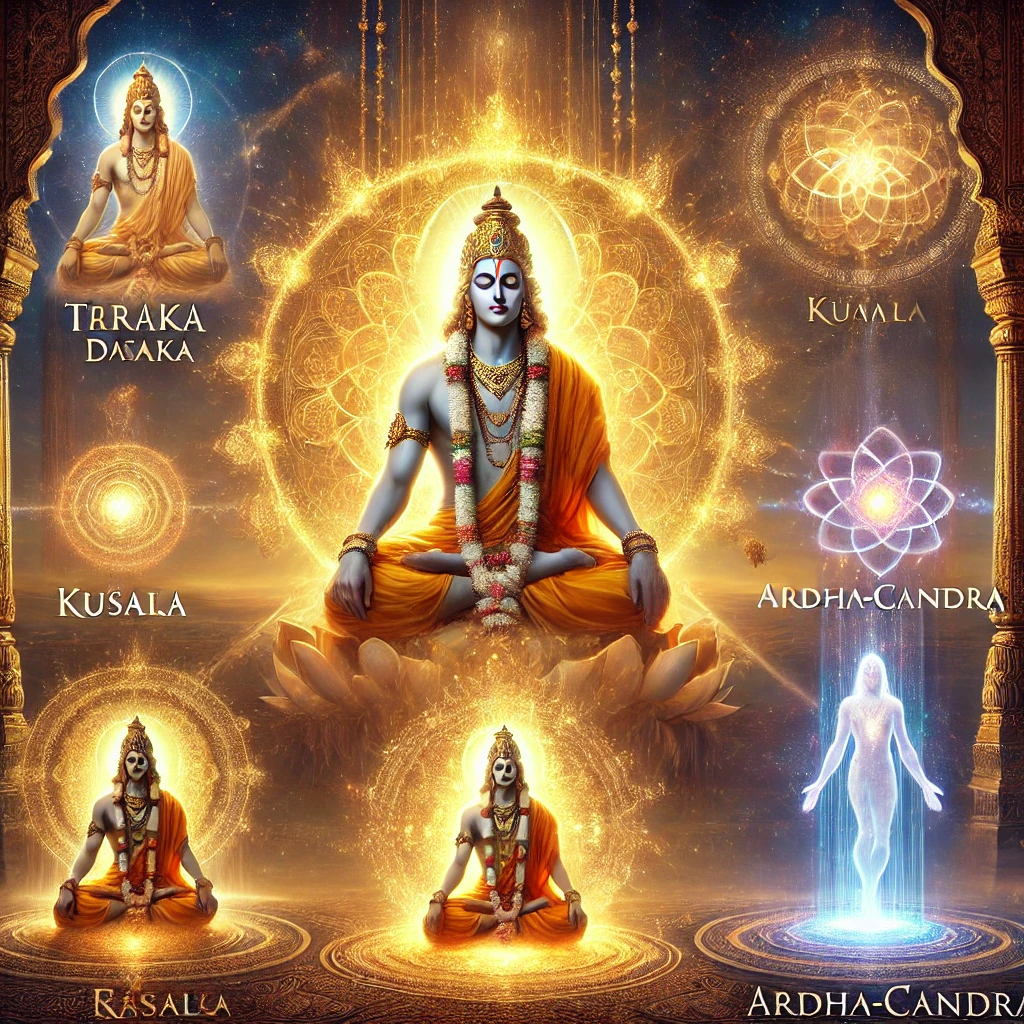
It is said that before his departure from the world, the great devotee Śrī Gosvāmi Tulasīdās was granted a divine revelation by Śrī Mahāvīra (Hanumānjī), in which the secret of the Rāma-Nāma was revealed to him. According to this revelation, the Rāma-Nāma, when analyzed, is found to contain five components (kalās or aspects). The first of these is called Tāraka, and the remaining four are known sequentially as Daṇḍaka, Kuṇḍala, Ardha-candra, and Bindu.

A human being moves through this material world bearing three bodies—the gross (sthūla), subtle (sūkṣma), and causal (kāraṇa). Without transcending Māyā, one cannot attain the fourth, Mahākāraṇa (the great causal body). A spiritual aspirant, following the path prescribed by the Guru, must dissolve all the components of the gross body into the first aspect of the name—Tāraka.

The gross body consists of the five elements (pañca-mahābhūtas):

  • The earth element (pṛthvī) manifests as bones, skin, etc.
  • The water element (jala) manifests as blood, reproductive fluids, etc.
  • The fire element (tejas) manifests as hunger, thirst, etc.
  • The air element (vāyu) manifests as movement, walking, etc.
  • The ether element (ākāśa) manifests as desire, anger, greed, etc.

Each element has five aspects, making twenty-five aspects in total. The same principle applies to the subtle and causal bodies. Through sādhana, when the five elements of the gross body dissolve into Tāraka, then the five elements of the subtle body must be merged into the second aspect—Daṇḍaka. Additionally, Tāraka itself dissolves into Daṇḍaka.

Following this, the elements of the causal body are merged into the third aspect—Kuṇḍala. With this, Daṇḍaka also merges into Kuṇḍala. After transcending the causal body, the pure sattva-dominated Mahākāraṇa Deha is merged into the fourth aspect of the name—Ardha-candra.

Up to this point, the entire process remains within the domain of jaḍa (inert material reality). However, while Mahākāraṇa Deha is still technically inert, it is pure, whereas the previous three bodies (gross, subtle, and causal) are impure. When Mahākāraṇa Deha is dissolved into Ardha-candra, only Kaivalya Deha (pure transcendental form) remains. This is the state of complete non-duality and pure divine existence.

The fifth and final aspect of the name is Bindu, which represents the supreme divine energy (Para-Śakti), identified with Śrī Jānakī (Sītā Devī). Without the shelter of Bindu, one cannot approach the transcendental Kalātīta Śrī Rāma (the Supreme Para-Brahman). Beyond Bindu lies the Repha, which represents Parabrahman Śrī Rāmacandra. When the inseparable love (anurāga) between Bindu-rūpiṇī Sītājī and Repha-rūpa Śrī Rāma reaches its pinnacle, one attains complete liberation (mokṣa) and can fully experience the true bliss of Rāma-Nāma.

Thus, those who relish the nectar of Rāma-Nāma do not separate Ardha-candra, Bindu, and Repha—they keep them united. In this singular unity, unfathomable and inconceivable divine pastimes manifest.

As Tulasīdās beautifully expresses:

“Tulasī metai rūpa nija bindu Sīya ko rūpa,
Dekhi lakhai Sītā hiye Rāghava Repha anūpa.”

(Tulasī says—when one dissolves oneself into the essence of the Bindu that is Sītā, then alone does one perceive in the heart of Sītā the unparalleled Repha that is Rāma.)

The Glory of the Name of Rāma Read More »

Prema Sādhana – Path of Love as Sādhana

In every form of sādhana (spiritual practice), the most superior path is the one that is natural. Even through artificial means, the disciplines of karma, jñāna, and love—i.e., bhakti—can be practiced, but such practice remains only an illusion. For true love-sādhana (devotional practice), first, bhāva-sādhana (the cultivation of spiritual emotion) is essential. Bhāva-sādhana is the practice of one’s natural disposition. It is free from any scriptural injunctions or prohibitions.

As long as there remains an identification with this material body, not only is love-sādhana impossible, but even bhāva-sādhana cannot be truly undertaken. Bhāva (spiritual emotion) is nothing but svabhāva (one’s natural disposition). However, our natural disposition is covered by the veil of māyā (illusion). The first step, therefore, is to remove this covering. There are many methods for this, among which mantra-śakti (the power of sacred sounds) is primary.

Until one attains the guidance of a sadguru (true spiritual teacher), it is appropriate to engage in preliminary practices such as nāma-sādhana (chanting the divine name) or other spiritual disciplines. However, these initial efforts are not true sādhana in the real sense. Without the grace of the sadguru, one cannot enter into the depth of the inner self. Continuous repetition of the divine name or other forms of devotion eventually lead to the bestowal of the guru’s grace. When the guru is attained, initiation (dīkṣā) into a systematic spiritual practice involving mantras and other disciplines is given.

Upon receiving dīkṣā, the sādhaka (practitioner) begins upāsanā (devotional worship). This process purifies the physical body as well as the mind (citta). The effect of this purification is the gradual removal of the veil of māyā. Within this veil, the inherent spiritual essence or svabhāva (natural state) of every soul remains concealed. When this covering is removed, the nijabhāva (one’s intrinsic spiritual nature) is revealed. This realization is known as attaining svabhāva.

The role of the Guru, Śāstra (scriptures), teachings, and examples is solely to facilitate the removal of this veil. However, what happens after this veil is lifted cannot be directly explained by either the Guru or the scriptures. This is because it is a state beyond negation (abhāva) and beyond intellectual comprehension. Nijabhāva (one’s intrinsic nature) is an experience unique to each soul.

Bhāva has two essential aspects:

  1. Bhāva-āśraya (the subject, i.e., the devotee).
  2. Bhāva-viṣaya (the object, i.e., the divine entity towards which devotion is directed).

The spiritual emotion (bhāva) arises when the bhāva-āśraya takes refuge in the bhāva-viṣaya. The devotee (bhakta) is the āśraya of bhāva, but this devotee is not merely a material being. The devotee is not limited to the sthūla-deha (gross body), sūkṣma-deha (subtle body), or even the kāraṇa-deha (causal body). Therefore, it is said that the bhāva-deha (spiritual body) is beyond māyā.

As long as the soul resides in a physical body, it naturally identifies with it. Similarly, when bhāva awakens, the sādhaka begins to identify with their bhāva-deha. In this state, the gross physical body ceases to cause distractions. If distractions persist, it indicates that the worldly emotions (jāgātika-bhāva) have not yet been purified.

For instance, an eighty-year-old devotee may experience bhāva-deha as a ten-year-old child. This occurs because, in the practice of worshipping the Divine Mother, the sādhaka enters a state where they experience themselves as a child before the Divine Mother. The bhāva-deha is not abstract—it has a specific form. This form carries an inherent ahaṁ-bhāva (sense of identity).

Without the realization of bhāva-deha, true bhāva-sādhana cannot take place, as it is not merely an intellectual exercise but an experiential reality. When the bhāva-āśraya (devotee) fully manifests within their bhāva-deha, then the divine abode (dhāma) begins to reveal itself. However, until bhāva reaches maturity, the corresponding divine subject (bhāva-viṣaya) does not manifest.

The maturity of bhāva is the essence of bhāva-sādhana. When bhāva ripens completely, it transforms into prema (divine love). This transformation is similar to the process of a flower developing fragrance. Eventually, this fragrance condenses into nectar (madhu), which symbolizes prema in its highest form.

When a flower is filled with nectar, it does not need to attract bees—they come automatically. Similarly, when bhāva matures into prema, the divine (bhagavat-svarūpa) spontaneously manifests. There is no need to invoke or summon the divine; it appears on its own. Until devotion (bhakti) attains the state of bhāva, and bhāva matures into prema, the direct experience of the Divine remains unattainable.

The Stages of Devotional Maturity

  • Bhāva matures into Prema (Divine Love)
  • Prema matures into Rasa (Transcendental Bliss)

Even within bhāva, a sense of duality remains, similar to the relationship between a mother and child. Although there is affection, complete unity has not yet been achieved. When love deepens, the state of total surrender (galanāt-huti) occurs. Eventually, this dissolves into rasa, where both the devotee and the Divine become one in transcendental bliss.

This is the highest state of devotional practice—a state where the soul attains eternal participation in the Divine’s transcendental pastimes. This cannot be achieved through mere ritualistic devotion (kriyātmikā-bhakti). Only when bhāva-bhakti matures into rasa can the devotee become part of the Divine’s eternal līlā (divine play).

Two Paths in Bhakti-Sādhana: Mādhurya & Aiśvarya

There are two main currents of devotional development:

  1. Mādhurya Bhakti (Sweet Devotion) – Where divine love deepens into rasa.
  2. Aiśvarya Bhakti (Majestic Devotion) – Where the devotee remains in awe of God’s supreme majesty.

In aiśvarya-bhakti, the devotee remains overwhelmed by the infinite power of the Divine, maintaining a distinction between themselves and the Divine. However, in mādhurya-bhakti, this distinction is dissolved, allowing for intimate union.

To fully experience this state, one must develop the sixty-four divine qualities (guṇas). When the soul perfects these qualities, it attains the highest expression of human potential (narottama—the supreme human). However, even at this stage, the soul remains distinct from the Supreme.

As the soul progresses from 51 to 56 divine qualities, it reaches a state close to the Divine’s essence. From 56 to 60, it begins to transcend māyā and enters bhagavad-bhāva (the divine consciousness). When the soul evolves further, from 61 to 64, it enters the innermost divine realm, attaining a state beyond even aiśvarya.

In this highest state, the devotee merges into the eternal, blissful play of the Divine. This is the pinnacle of love-sādhana—where love transforms into rasa, and the soul attains perfect union with the Divine. Without the maturity of love, especially without the influence of rāgamayī-bhakti (spontaneous devotion), the Divine cannot be realized in its fullest essence.

Prema Sādhana – Path of Love as Sādhana Read More »

The Evolution of Śakti from a Kaula Perspective

From the Kaula perspective, the evolution of Śakti follows a unique trajectory. The followers of the Śānta tradition are predominantly Advaita-oriented. Among Śāktas, various viewpoints exist, yet the Kulāmnāya perspective is particularly noteworthy. According to this view, the supreme essence that exists beyond the manifested world is known as Akūla. It is likened to an infinite, boundless ocean. When no waves arise in this ocean, it signifies the state of Viśvatirōdhāna, wherein the universe remains concealed.

Among the five primary acts of the Supreme Lord (Parameśvara), Tirōdhāna (concealment) and Anugraha (grace) are the most significant. In the state of Tirōdhāna, the divine essence remains hidden, forming the background against which the entire cosmos, composed of the knower (pramātā), the knowable (prameya), and all related entities, emerges. This universal play continues until the final dissolution. Eventually, when Anugraha-Śakti is activated, the work of Tirōdhāna-Śakti comes to an end, and the Supreme Reality is revealed in its full glory.

This Akūla Ocean should be understood as infinite, boundless consciousness. As long as the play of Tirōdhāna-Śakti persists, there is no emergence of waves. However, when the urmi (waves) begin to arise, it indicates the retreat of Tirōdhāna-Śakti. These waves are Anugraha (grace) in motion, manifesting as vibrations (spanda). Any individual (jīva) or bound being (paśu) that comes in contact with this spanda begins to undergo a transformation, which, through progressive stages, leads to the ultimate and supreme state of realization.

This spanda is merely a wave within the Ocean of Consciousness (Bodhāsamudra). It represents the emergence of Cit-Śakti. As Vitti-Śakti (the power of cognition and manifestation) expands, it dissolves the various distortions and modifications (vikalpa) of the universe, which are rooted in fundamental ignorance (avidyā). Jīvas and paśus, who have dwelled in the realm of vikalpa since beginningless time, experience a transformation when Anugraha-Śakti, awakened through Vitti-Śakti, touches them. Their perception of reality changes, leading to a transformation in their very existence.

Upon awakening, Viśakti (specialized Śakti) first consumes Kāla (Time) because, in Kaula philosophy, the evolution of Śakti within a being follows the trajectory of time, which is the root cause of conditioned perception (vikalpa). Therefore, this Śakti is known as Kāla-Saṁkarṣiṇī. When Kāla is dissolved, the jīva is no longer bound by its limitations. However, this process is gradual.

The Process of Purification

The first step in this progressive purification is Prameya-Śuddhi (purification of the knowable world). Without Prameya-Śuddhi, transformation in a jīva does not take place.

The fundamental characteristic of Prameya-Śuddhi is the realization that the universe does not appear as external. When one realizes that the self is distinct from the body, the world ceases to appear as external. This is the essence of Prameya-Śuddhi. The dissolution of external appearances follows this realization.

Upon achieving Prameya-Śuddhi, the external world does not vanish, but its mode of perception changes. The world still exists and is perceived, but no longer as something external—it is realized within oneself. This is akin to how an image reflected in a mirror appears separate from the mirror but actually exists within it. Likewise, when Cit-Śakti (Consciousness-Power) awakens, the external perception of the universe dissolves.

The knower (pramātā) still perceives the knowable (prameya), but not as an external entity. This awakened Cit-Śakti, in its bubhukṣā (intensely seeking) state, first assimilates the external world into itself. This is the first manifestation of Anugraha-Śakti (the grace-bestowing power).

Śaṅkarācārya’s Insight on External Perception

Śaṅkarācārya describes this transformation:

“Viśvaṁ darpaṇa-dṛśyamāna-nagarī-tulyaṁ nijāntargatam māyayā bahir iva udbhūtam”

(“The universe, like a city seen in a mirror, is within oneself, though it appears externally due to illusion.”)

Thus, the essence of this philosophy is that Cit-Śakti absorbs the external world into itself. The knowable world (prameya) does not cease to exist, but it is no longer perceived as an object of the senses—it becomes a part of one’s own being.

In Viśarga-Śakti, the world appears external to the Self, while under the influence of Bindu, it is internalized. Through this process, Cit-Śakti assimilates all objects, eliminating their objectivity. As a result, sensory enjoyment ceases—objects no longer evoke desire or attachment. Instead, knowledge of objects transforms into pure rapture (rāga), which the Parāśakti experiences in a non-dual, unconditioned manner.

The Awakening of Śakti and the Role of the Vīra

This awakening of Cit-Śakti marks the first stage of spiritual realization, known as Prameya-Śuddhi. However, this experience is not for the bound jīva or the ordinary being (paśu). From a Tāntric perspective, it is the domain of the Vīra (spiritual warrior)—a true experience of Bhoga (enjoyment), which transcends worldly pleasure and leads to Turīya (the fourth state beyond waking, dreaming, and deep sleep).

The experiencer of this state is known as Vīreśvara or Mahāvīra. In Śiva-Sūtras, Vīreśvara is described as the Bhoktā of the three states (waking, dream, and deep sleep), while the conditioned being (paśu) remains entangled in them.

This state constitutes the real worship of the Divine, where all senses become instruments of worship. The act of seeing forms with the eyes or hearing sounds with the ears is transformed into a mode of worship and meditation. This is the true Bhagavad-Ārādhana (divine worship), which remains uninterrupted in all states of existence. Śaṅkarācārya states:

“Yad yad karma karomi tat tad akhilaṁ śambho tavārādhanam”

(“Whatever actions I perform, all are an offering unto Śiva.”)

Upon the completion of this experience of the Vīra, the state of Tuṇī (withdrawal) arises, leading to the emergence of Antarmukha-dashā (inward absorption). In this state, the senses, having been satisfied, turn inward and merge into the boundless space of consciousness (Cidākāśa), attaining oneness with Bhairavanātha.

As long as the senses harbor a desire for sensory pleasures, this state does not arise. But when all sensory cravings dissolve, the mind and prāṇa (life-force) also cease to function. This means that the relationship between the knower (pramātā) and the known (prameya) ceases.

The Ultimate State: Anākhyā and Paramaśiva

This ultimate state is called Mahāyoga, where both Sun (Prāṇa) and Moon (Mind) dissolve. It is akin to spiritual Śivarātri, a state of total awareness. The yogi, even in this non-dual state, must remain vigilant (jāgran), lest they fall back into illusion (Mahāmāyā).

The final stage is the emergence of Nirāvaraṇa Prakāśa (Unveiled Light), which is the supreme goal of the Jīva. This state is called Anākhyā—beyond all descriptions. The ascent from Anākhyā to Bhāsā (Self-luminous Consciousness) occurs through successive spiritual stages, ultimately leading to the realization of Paramaśiva, where even Mahākāla (Great Time) is transcended.

The Evolution of Śakti from a Kaula Perspective Read More »

The Temple of Śrī Mātā

This universe is the eternal abode of the Supreme Power (Parāśakti), Śrī Jaganmātā. It is the realm of her divine play (Līlā) and also the eternal sanctuary beyond play. Accomplished Yogis (Siddha Yogis), depending on their individual spiritual perspectives, perceive the temple of the Divine Mother through the path they follow.

The processes of creation (Sṛṣṭi), preservation (Sthiti), and dissolution (Saṁhāra) are continuously occurring in the outer domains of the cosmos. However, in the inner sanctum of the universe, no such turmoil or movement exists. There, in an atmosphere of profound peace, the Mother is seated in complete harmony with the Supreme (Parameśvara). The vibrations of creation and destruction do not reach this inner sanctum.

The Universal Mother and Universal Father reside there in their absolute, indivisible, and immutable essence, beyond all duality and conflict. Here, Śakti’s pulsation (Spanda) and Śiva’s eternal stillness (Asyandana) exist in a non-dual, harmonious state. The universe is the manifestation of Mahāśakti, but before it manifests into form, it remains in absolute unity with Mahāśakti. Paramaśiva (the Supreme Śiva) eternally witnesses the cosmic form of Śakti, which is none other than His own inherent nature.

Śiva, in His essence, is inactive (Niṣkriya) and formless (Nirākāra), while Śakti is dynamic (Sākriya) and possesses form (Sākāra). In their supreme aspect, they are eternally present as a single great point (Mahābindu). In this Mahābindu, an undivided, complete existence resides—the Supreme Non-Dual Reality (Paramādvaya). It is Śiva while being Śakti and Śakti while being Śiva.

Understanding Cosmic Creation

To comprehend the creation of the universe, one must meditate deeply and steadily upon the nature and function of the Mahābindu. In the technical terminology of scriptures, this Mahābindu is known as the Kāma-Rūpa Bindu. The great seers of absolute truth (Ṛṣis) have recognized it as Ravi (the Sun) or Ātmic Sun (Ātmārūpa Sūrya).

This state represents the absolute equilibrium of power (Śakti). It is the eternal synthesis of creation, preservation, and destruction. Within it, two opposing forces continuously engage in attraction (Ākarṣaṇa) and repulsion (Vikarṣaṇa). Through this cosmic play of attraction and repulsion, the processes of manifestation and dissolution continuously unfold. However, within this great play, there remains a central, unmoving, eternal point of equilibrium—the stationary Bindu (Sthiti Bindu).

  • One of the two opposing points is Agni (Fire), which is of the nature of heat and destruction. Its function is to dissolve and collect the dispersed energies.
  • The other point is Soma (Nectar), which is cooling and nourishing.

Both Agni and Soma represent the interplay of infinite opposing forces, while the central point (Sthiti Bindu) represents the harmony of all contradictions.

On one side, the Sthiti Bindu remains eternally stable, while on the other, the dynamic Bindu continuously generates and dissolves Agni and Soma. The processes of creation (Sṛṣṭi) and destruction (Saṁhāra) are contained within them.

Different Ṛṣis (sages) and Siddha beings (enlightened souls) attempt to understand this universal cycle through their own devotional insights (Iṣṭa Bhāva). They seek to comprehend the movement from the external to the internal realms and vice versa. Over time, various geometrical representations, sacred diagrams (Yantras), and Chakras (mystical circles) have been formulated in the science of Tantra.

Each Yantra (sacred diagram) consists of an outer enclosure (Bhūpura) and a central Bindu (dot of energy), which is a universal truth. The hierarchy and variations of these structures are not necessary for our discussion here. Instead, we will focus on the most renowned representation of this cosmic process—the Śrīcakra.

Śrīcakra: The Sacred Diagram of Śrī Mātā

The Śrīcakra is the Yantra (sacred diagram) of Śrī Mātā and a symbolic representation of the structure of the universe. Within this Yantra, every being and every energy has a place at the central Bindu or Mahābindu.

From this Bindu, the flow of creation emerges, and it is also where this flow ultimately finds peace and dissolution. It is important to understand that the equilibrium of the Mahābindu is the reference point of this entire process.

Even though the Mahābindu remains eternally stable, it is also continuously in motion. Thus, it is simultaneously unmoving and vibrating.

Within this Mahābindu:

  • Two opposing Bindu points interact, generating the forces of creation and dissolution.
  • A third, harmonizing Bindu constantly exists in perfect equilibrium.

From these three Bindus, three lines emerge, and from their intersections, a triangle (Trikoṇa) is formed. This triangle is understood as the Cosmic Womb (Yoni) and the Mother Principle (Mātṛmaṇḍala) that gives birth to universal creation.

The Triadic Foundation of Creation

The Vedāntic philosophy states: “Yoneḥ Śarīram”—the body originates from the womb. The entire structure of creation is formed from the interaction of Bindu (dot) and Yoni (womb).

Upon deeper contemplation of creation’s origin, it becomes evident that:

  1. One aspect of existence is indivisible (Niraṁśa), beyond all vibration and eternally still.
  2. The other aspect is divisible (Saṁśa), manifesting as movement and activity.

The indivisible aspect (Niraṁśa Sattā) is beyond vibration, eternally peaceful, and represents Śiva (pure consciousness). Within this indivisible reality, Śiva and Śakti exist as one, without distinction.

This indivisible field remains forever beyond the grasp of the mind and intellect. However, within the divisible aspect (Saṁśa Sattā), there are two expressions:

  1. Śiva as the consciousness aspect (Jñāna)—called Ambikā (the motherly aspect of Śakti).
  2. Śakti as the dynamic aspect (Kriyā)—called Śāntā (the tranquil aspect of Śakti).

From these two currents (Ambikā and Śāntā), the formation of the triangular Yoni (Womb) occurs, which is the fundamental principle behind the structure of the universe.

This mystical triangular structure at the core of the Śrīcakra remains one of the most profound mysteries in Tantra and Yoga.

Conclusion: The Temple of Śrī Mātā as the Supreme Reality

The Śrīcakra is both the cosmic diagram and the divine abode of Śrī Mātā. It represents:

  • The interplay of Agni and Soma (fire and nectar)
  • The harmony of Śiva and Śakti
  • The balance of stillness and movement
  • The eternal cosmic cycles of creation and dissolution

Through deep meditative contemplation (Dhyāna Yoga) upon this great mystery, the seeker realizes the unity of self, universe, and the Divine Mother.

This temple of Śrī Mātā is not merely a structure in the external world—it is the cosmic blueprint of all existence.

The Temple of Śrī Mātā Read More »

Śrīcakra by Mahāmahopādhyāya Dr. Gopinath Kaviraj

There have been various discussions in both ancient and modern global literature regarding universal prosperity (Viśvamṛddhi). Thinkers from different traditions have expressed their perspectives, each based on a specific worldview and established truths. In this article, I will briefly discuss certain aspects of the cosmic principle (Sṛṣṭi Tattva) from the Śākta tradition within the Indian philosophical framework.

The universal existence and the individual body are fundamentally the same essence. Tantric scholars assert that what yogis refer to as the manifestation of the Bindu (the primordial dot) is merely a variation in terminology. In other words, the emergence of the Śrīcakra, the creation of the universe, and the manifestation of the soul through the body are essentially the same phenomenon.

Śakti: The Undivided Existence

According to Śākta philosophy, the unchanging essence (Akhaṇḍa Sattā) at the root of the universe is both the material cause (Upādāna) and the instrumental cause (Nimitta) of the cosmos. It neither increases nor decreases; it is eternal, beginningless, self-luminous, and of the nature of consciousness and bliss (Cidānanda Svarūpa). This state is known as the non-dual union of Śiva and Śakti (Śiva-Śakti Advaitāvasthā).

In His Śiva aspect, this essence remains detached, inactive, and an absolute witness, while in its Śakti aspect, it becomes the manifesting principle of the universe. Although Śiva and Śakti are inherently united, Śiva is neutral and unchanging, whereas Śakti is in constant expansion and contraction.

Śiva and Śakti: The Interplay of Cosmic Forces

The ancient yogis attempted to explain the supreme principle through the perceptible realities of the universe. They argued that what we call Śiva in ordinary discourse is actually an aspect of Śakti, because even Śiva cannot be conceived of without Śakti. Without Śakti, Śiva cannot be described in any way. This is emphasized in Tantric texts:

“Śaktyā vinā para Śive nāma dhāma na vidyate”
(Without Śakti, even the Supreme Śiva has neither name nor abode.)

At the root of the universe, there exists a play of two opposing aspects of Śakti. In one state, they remain harmonized and non-dual, while in another, they engage in dynamic interaction. These two aspects are known as Agni (Fire) and Soma (Moon or Nectar).

  • Agni (Fire) is associated with dissolution, destruction, and time (Kāla).
  • Soma (Nectar) is associated with bliss, immortality, and expansion.
  • Agni disintegrates the undivided entity into distinct forms, whereas Soma unifies the fragmented into a singular whole.
  • Agni is the principle of destruction, while Soma is the principle of nourishment and joy.

When Agni and Soma remain in equilibrium, no creation or destruction occurs, leading to the eternal state (Nitya Avasthā), symbolized as Ravi (the Sun) or Surya. From this perspective, the science of the Sun (Sūrya Vijñāna) is rooted in the idea that the eternal force of creation and destruction is present within the Sun.

  • When Soma dominates, creation occurs.
  • When Agni dominates, destruction follows.

The Supreme State (Advaita) is the perfect balance of Agni and Soma, which is symbolized in Tantric texts as Kāma (desire) and Ravi (the sun).

Bindu: The Origin of Creation

The origin of all existence is the Bindu (the cosmic point), which divides into three primary states:

  1. Amba (Mother) – The illuminating aspect (Jñāna Śakti, the Power of Knowledge)
  2. Śāntā (Tranquil) – The reflective aspect (Icchā Śakti, the Power of Will)
  3. Raudrī (Fierce) – The dynamic aspect (Kriyā Śakti, the Power of Action)

These three aspects together form the Mūla Trikoṇa (the primordial triangle), which is the root of the Śrīcakra.

The Śrīcakra is the cosmic blueprint, reflecting the entire structure of existence from its subtlest spiritual form to its grossest physical manifestation. This triangular formation later gives rise to multiple layers of manifestation, represented in the Sacred Geometry of the Śrīcakra.

The Evolution of the Śrīcakra

The Śrīcakra consists of multiple concentric layers, each symbolizing different aspects of cosmic manifestation:

  1. Mahābindu – The Supreme Bliss (Sarvānandamaya Cakra)
  2. Triangular Formation (Trikoṇa) – The Source of All Accomplishments (Sarvasiddhiprada Cakra)
  3. Eight-Petaled Structure (Aṣṭakoṇa) – The Protector of All (Sarvarakṣākara Cakra)
  4. Inner and Outer Decagonal Formations (Daśakoṇa) – The Bestower of All Wealth and The Remover of All Diseases (Sarvārthasādhaka and Sarvarogahara Cakras)
  5. Fourteen-Petaled Layer (Caturdaśāra) – The Bestower of All Auspiciousness (Sarvasaubhāgyasādhaka Cakra)
  6. Eight-Petaled Lotus (Aṣṭadala Kamala) – The Condenser of All Desires (Sarvasaṅkṣepaka Cakra)
  7. Sixteen-Petaled Lotus (Ṣoḍaśadala Kamala) – The Fulfiller of All Wishes (Sarvāśāparipūraka Cakra)
  8. Three Concentric Circles (Trivṛtta) – The Deluder of the Three Worlds (Trailokyamohana Cakra)

The outermost layer, known as Bhūpura, represents the boundary of existence, beyond which the manifested universe dissolves into non-duality.

Śrīcakra as the Supreme Reality

The Śrīcakra is a reflection of the Supreme Power (Mahāśakti) and the entire cosmic order. The human body and the vast universe are merely transformations of this fundamental reality.

According to the Bhāvanopaniṣad, during internal worship (Āntara Yāga) or deep meditation (Ātma-Dhyāna), the practitioner should envision their own body as the Śrīcakra. This unique perspective allows the sādhaka to experience the non-duality between the body, the universe, and the Supreme Reality.

Time and Space in the Śrīcakra

The manifestation of external reality is dependent on space (Deśa) and time (Kāla). The phases of the moon represent the fifteen divine energies (Nityā Devis), who regulate the cosmic flow of time. In the Tāntric system, these energies are associated with specific lunar phases and must be meditated upon as inseparable from the Supreme Goddess Lalitā-Tripurasundarī.

The Śrīcakra is eternally present within the cosmic cycle of time and space, and its presence is never separate from reality. In this sense, the Śrīcakra is not an external entity, but an inner reality embedded in the fundamental structure of existence.

Conclusion

The Śrīcakra represents the ultimate unity of Śiva and Śakti, creation and dissolution, motion and stillness. It is both the foundation and the ultimate goal of all existence. The interplay of Agni and Soma, Śakti and Śiva, light and reflection continuously governs the cycle of creation, preservation, and dissolution. Those who comprehend this mystery through deep spiritual practice gain insight into the essence of the cosmos itself.

Śrīcakra by Mahāmahopādhyāya Dr. Gopinath Kaviraj Read More »

Why Guru is important in Sadhana by — Mahāmahopādhyāya Paṇḍita Gopīnātha Kavirāja

The method of Sādhana (spiritual practice) is known only through the Guru (spiritual teacher). Describing the method of any sādhana in scriptures only leads to misuse and malpractice, because a sādhaka (practitioner) cannot correctly understand the process merely by reading about it in texts. It is only through a Guru that one can truly comprehend it.

This is the reason why I have not described the methods of sādhana in my texts.

In the Bhagavad Gītā, Bhagavān Śrī Kṛṣṇa has stated:

“Apāne guhati prāṇaṃ prāṇāpāna-samānayoḥ”

(One should merge Apāna Vāyu into Prāṇa Vāyu, and Prāṇa Vāyu into Apāna Vāyu).

Can anyone truly understand this process without the guidance of a Guru?

Mahāmahopādhyāya Paṇḍita Gopīnātha Kavirāja

Why Guru is important in Sadhana by — Mahāmahopādhyāya Paṇḍita Gopīnātha Kavirāja Read More »

Essence of Tantra – Lesson 07

This post is a summary of the class series “Essence of Tantra” conducted by Sri Shakthi Sumanan, offering profound insights into the foundational principles of Tantra. These notes serve as a reference for participants and are not self-explanatory; their true depth and meaning can only be understood through active participation in the class discussions and experiential learning sessions.

Introduction

The Goddess (Devī) represents the supreme cosmic power and is the essence of all creation, sustenance, and dissolution. She is the Śakti, the dynamic energy of the universe, and the counterpart of Śiva, the unchanging consciousness. This passage explores the many aspects of Devī, from Her cosmic manifestations as Māyā and Mahāmāyā, to Her forms in human worship and spiritual practices. It also examines the roles of Devī in relation to creation, liberation, and the unity of the universe, emphasizing Her prominence in the Tantric tradition.

To make these profound teachings accessible, let us simplify the key concepts.


Simplified Explanation of Concepts

1. Devī as the Great Śakti

  • Śakti means energy or power, and Devī is the supreme Śakti who governs and manifests the universe.
  • She is described as:
    • Māyā: The force through which the one reality, Brahman, appears as the manifold world (saṃsāra).
    • Mahāmāyā: The supreme illusion, beyond ordinary māyā, as She creates and governs the universe.
    • Avidyā (Nescience): Binding beings to the cycle of life and death (saṃsāra).
    • Vidya (Knowledge): Liberating beings by revealing the truth and leading them to mokṣa (liberation).

Devī is the Prakṛti (Nature) and the Ādyā Śakti (Primordial Energy), existing before creation as the source of all manifestation.


2. Devī as Cit-Śakti

  • Cit-Śakti refers to the conscious energy of the Absolute (Brahman).
  • Devī is both:
    • Vācaka-Śakti: The expression of consciousness (Cit) in Prakṛti.
    • Vāchya-Śakti: Cit itself, the essence of pure consciousness.

In Her motherly aspect (Śrī-mātā), Devī nourishes and sustains the worlds. She is the personification of Sat (Existence), Cit (Consciousness), and Ānanda (Bliss).


3. Devī’s Forms

Devī manifests in three primary forms:

  1. Para (Supreme Form): Beyond form and qualities, incomprehensible and infinite.
  2. Sūkṣma (Subtle Form): The form of mantras, accessible through spiritual practices and meditation.
  3. Sthūla (Gross Form): The physical form with human-like attributes, celebrated in scriptures and worshipped in temples.

4. Devī as the Source of Creation

  • Devī is the source of Brahmā (Creator), Viṣṇu (Sustainer), and Maheśvara (Destroyer).
  • She is often depicted in Her female forms, which are particularly revered in Tantra. For example:
    • Sarasvatī: Goddess of knowledge and wisdom.
    • Lakṣmī: Goddess of wealth and prosperity.
    • Durgā: The fierce protector.
    • Tripurā-sundarī: The beautiful one who governs the three worlds.

Her cosmic play is described as the līlā (divine play), where countless worlds appear and disappear as reflections of Her energy.


5. The Daśa-Mahāvidyās (Ten Great Wisdoms)

  • As Sati, Devī manifests in ten forms, known as the Daśa-Mahāvidyās:
    1. Kālī: The fierce goddess of time and destruction.
    2. Tārā: The savior and protector.
    3. Tripurasundarī (Śrī Vidyā): The goddess of beauty and supreme knowledge.
    4. Bhuvaneśvarī: The ruler of the worlds.
    5. Chinnamastā: The self-decapitated goddess, symbolizing self-sacrifice.
    6. Bhairavī: The terrifying goddess who destroys ignorance.
    7. Dhūmāvatī: The widow goddess, representing inauspiciousness and transcendence.
    8. Bagalāmukhī: The paralyzer of enemies and obstacles.
    9. Mātangī: The goddess of speech and music.
    10. Kamalātmikā (Lakṣmī): The goddess of prosperity and beauty.

Each of these forms represents a unique aspect of Devī’s cosmic energy.


6. Devī and the Fifty-One Śakti Pīṭhas

  • After the death of Sati during Dakṣa’s yajña (sacrifice), her body was divided into 51 fragments by Viṣṇu’s discus. These fragments fell to the earth, forming the Śakti Pīṭhas, sacred places of worship where Devī resides with Her consort Bhairava.

7. Devī in the Human Body: Kuṇḍalinī

  • Devī exists in the human body as Kuṇḍalinī, the coiled energy resting at the base of the spine (mūlādhāra chakra).
  • When awakened, Kuṇḍalinī rises through the chakras, leading to spiritual liberation and unity with the supreme consciousness.

8. Devī as the All-Encompassing Reality

  • Devī is described as:
    • The universe itself: All forms, animate and inanimate, are Her manifestations.
    • The Supreme Life: The flowering beauty and diversity of the universe are expressions of Her infinite energy.
    • The Sun and Moon, and all deities and beings, are parts of Her cosmic form.

In the Śākta-Śāstras and Tantras, Devī is worshipped as the ultimate reality, with all other forms being Her reflections.


9. The Highest Worship

  • The highest form of worship is nirādhārā, where Devī is realized as the pure intelligence within the Self. Through inner realization, the sādhaka (spiritual practitioner) transcends the external forms and realizes Devī as the supreme witness of all creation.

Key Takeaway

Devī represents the ultimate cosmic power, uniting creation, sustenance, and dissolution. As Śakti, She is the dynamic force of Śiva, manifesting in countless forms and energies. Whether as the primordial energy of creation, the liberator of souls, or the coiled Kuṇḍalinī within us, Devī permeates all existence. Her worship in the Tantric tradition emphasizes self-realization, unity with the supreme consciousness, and the understanding that all diversity is but an expression of Her infinite play.

Essence of Tantra – Lesson 07 Read More »

Essence of Tantra – Lesson 06

This post is a summary of the class series “Essence of Tantra” conducted by Sri Shakthi Sumanan, offering profound insights into the foundational principles of Tantra. These notes serve as a reference for participants and are not self-explanatory; their true depth and meaning can only be understood through active participation in the class discussions and experiential learning sessions.

Introduction

This section explores profound metaphysical concepts from the Tantric tradition, particularly focusing on the interplay of Śiva and Śakti—the ultimate cosmic principles that underpin creation, existence, and dissolution. It delves into the intricate relationships between the guṇas (sattva, rajas, tamas), the creation process, and the role of Śakti as the active force behind manifestation. The text also introduces key elements of the human spiritual experience, such as Kundalinī and the chakras, while elaborating on the stages of cosmic evolution from the unmanifested (avyakta) to the manifested universe.

To make these teachings accessible, let us break down the key concepts step by step for better understanding.


Simplified Explanation of Concepts

Śiva and His Manifestations

  • Śiva is the unchanging, eternal consciousness that descends into different states and forms to manifest the universe.
  • He is addressed by various names—Śambhu, Sadā-śiva, Śaṃkara, Maheśvara, etc.—each reflecting different aspects of His nature and qualities:
    • Śambhu: Auspicious and benevolent.
    • Sadā-śiva: Represents the predominance of sattva (purity and illumination).
    • Maheśvara: The great lord overseeing the cosmos.
  • The Śiva-Purāṇa and Mahābhārata list numerous names (e.g., 1,008) reflecting these diverse manifestations.

Śakti: The Dynamic Energy of Creation

  • Śakti is the active, dynamic force of Śiva. She is both:
    • Māyā: The power through which Brahman creates the illusion of differentiation in the universe.
    • Mūla-prakṛti: The root nature or unmanifested potential that transforms into the universe of names and forms.
Śakti and the Guṇas
  • Śakti contains the three guṇas, which define the structure and dynamics of creation:
    1. Sattva: Illuminating and revealing (manifesting clarity).
    2. Rajas: Activating and dynamic (driving change and action).
    3. Tamas: Veiling and stabilizing (producing inertia and concealment).
  • The triad of guṇas represents:
    • The descent of spirit into matter (as creation evolves).
    • The ascent of matter back to spirit (as beings return to the source).
    • The dense veil of spirit concealed within material nature.

Creation and the Role of Śiva-Śakti

  1. Mūla-prakṛti as the Womb of Creation
    • Mūla-prakṛti is the primordial womb into which Brahman (Śiva) plants the seed of creation.
    • The active force of rajas disturbs the equilibrium of the guṇas, initiating creation.
  2. Śiva and Śakti in Manifestation
    • The illuminating consciousness of Śiva (cit) works through Śakti to create the universe, which is governed by the dual principles of Maheśvara (Śiva) and Maheśvarī (Śakti).
    • Together, Śiva and Śakti pervade the entire cosmos and are symbolized in the human body as:
      • Svayambhū-liṅga: The self-manifested aspect of Śiva in the mūlādhāra chakra.
      • Kundalinī-Śakti: The coiled divine energy lying dormant in the mūlādhāra.

Kundalinī: The Coiled Energy

  • Kundalinī means “the coiled one” and is depicted as a serpent resting at the base of the spine in the mūlādhāra chakra.
  • She is the vital energy (jīva-śakti) that animates all life and manifests as prāṇa (life force).
  • Kundalinī has three and a half coils, corresponding to:
    • The three guṇas and the half bindu mentioned in the Kubjikā-Tantra.
  • When awakened, Kundalinī ascends through the chakras, leading to higher states of consciousness.

Stages of Cosmic Creation

The cosmic evolution begins with the unmanifested avyakta and progresses through various stages:

  1. Avyakta (Unmanifested State):
    • The state of Mūla-prakṛti in perfect equilibrium.
  2. Mahat (Cosmic Intelligence):
    • The first manifestation, where the three guṇas become distinctly evident.
  3. Ahaṃkāra (Selfhood):
    • Ahaṃkāra develops in three forms:
      • Sāttvika (Pure): Produces the senses and divine forces.
      • Rājasika (Active): Governs dynamism and change.
      • Tāmasika (Dense): Gives rise to the elements and the subtle essences (tanmātrās).
  4. Tanmātrās and Tattvas:
    • The tanmātrās (subtle essences) are associated with the five elements:
      • Ether (sound), Air (touch), Fire (sight), Water (taste), Earth (smell).
    • These essences evolve into the tattvas (principles of creation).

The Vaikrta Creation

  • The process of creation bifurcates into:
    • Prākṛta (Belonging to Prakṛti): The initial stages of creation (e.g., elements, senses).
    • Vaikrta (Modified Creation): Includes all life forms, such as:
      • Vegetation: Life currents move upwards.
      • Animals: Life currents are horizontal.
      • Spirits (Bhūta, Preta, etc.): Life currents tend downward.

Key Takeaway

This passage illustrates the intricate dynamics of creation, highlighting the interplay of Śiva (pure consciousness) and Śakti (dynamic energy). The universe arises through a systematic process, starting with the unmanifested potential of Mūla-prakṛti, moving through cosmic intelligence, and culminating in the diverse forms of life and matter. These teachings not only reveal the cosmic processes but also emphasize the divine forces present within the human body, such as Kundalinī, inviting us to explore our inner spiritual potential and align with the universal principles of Śiva-Śakti.

Essence of Tantra – Lesson 06 Read More »

You cannot copy content of this page