Spiritual Kashi
Spiritual Kashi
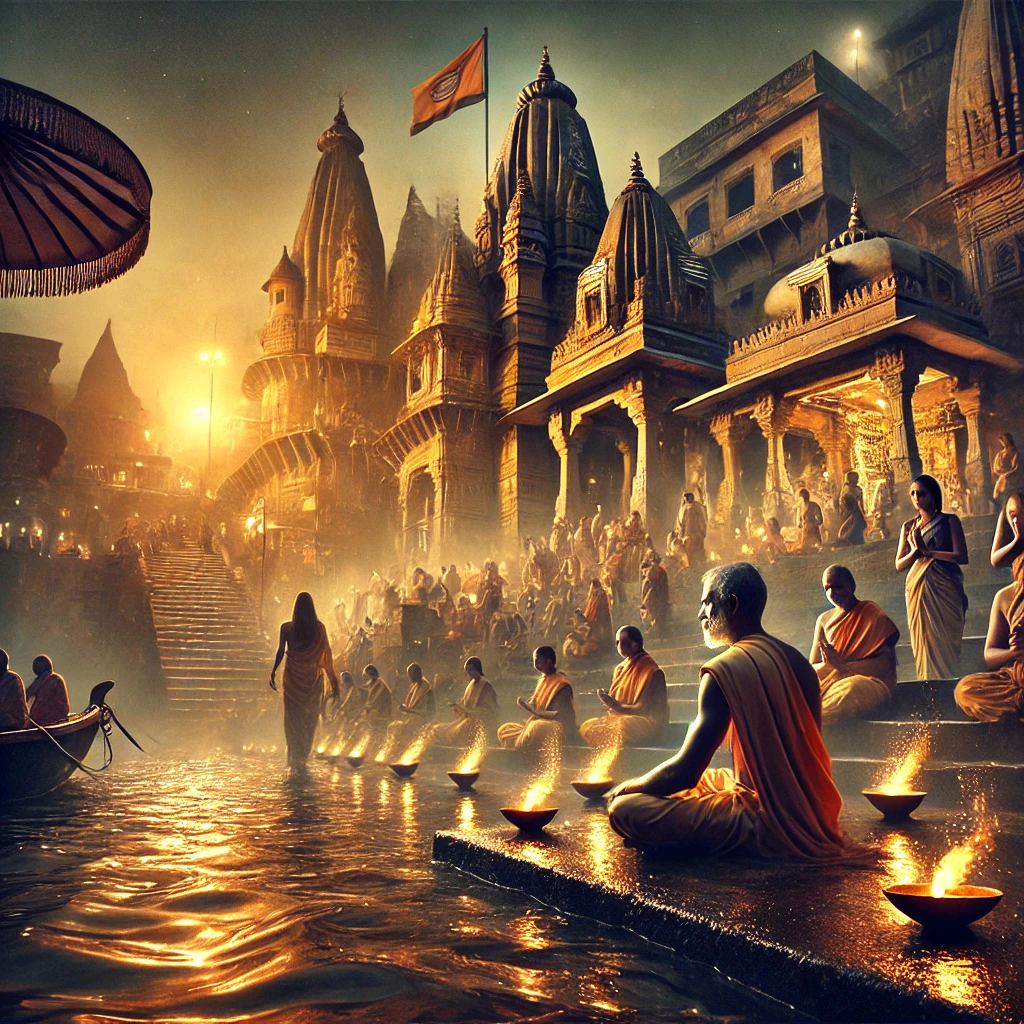
Bhagavan Shankaracharya has mentioned a spiritual Kashi in one of his hymns: “Sākāśikā’hnijayodharūpā.” The Kashi with which we are familiar today is a physical location—a specific region on Earth. Due to its unique spiritual significance, this land has been transformed into Mukti-Kṣetra (a field of liberation), as it is widely believed that death in Kashi grants liberation to the soul. This Kashi is situated on the banks of the north-flowing Ganga in India, a well-known fact.
From the perspective of sacred geography, this physical Kashi surpasses other pilgrimage sites in its divine glory. While other locations such as Uttarkashi, Guptakashi, and Dakshina Kashi are renowned, their sanctity is not as profound as that of the Kashi located between the Varuna River to the north, the Assi River to the south, and the Ganga flowing through its center. The greatness of this Kashi is that merely by dying here, Lord Vishwanath himself grants liberation to the soul, ensuring its upward journey. Elaborating further on this is unnecessary.
However, the Nijayodha-rūpā Kashi mentioned by Bhagavan Shankaracharya is something beyond the physical realm. The essence of this Kashi is Nijabodha (self-awareness) or Ātmabodha (self-realization). This Kashi is accessible only to the Jñānī (one who possesses wisdom), while an Ajñānī (ignorant person) cannot perceive it. It is well known that ordinary beings exist within the three states of Jāgrat (wakefulness), Svapna (dream), and Suṣupti (deep sleep), cycling through them repeatedly due to ignorance. Until ignorance is dispelled, this cycle continues. These three states correspond to Samsāra (worldly existence), Jñānī’s state (state of wisdom), and Jīvanmukti (state of living liberation).
Spiritual Kashi is revealed when, through the grace of the Sadguru, an individual attains wisdom. At that moment, one becomes aware of an absolute, transcendental reality. With the radiance of true knowledge, the upward movement of the soul unfolds, and the identification with the body gradually dissolves. The force of gravitational attraction fades, and a spontaneous ascent begins—rising from the Mūlādhāra (root chakra), piercing through the Ājñā Chakra (third eye center), and reaching the Sahasrāra (crown chakra) and Brahmarandhra (the aperture at the crown of the head).
In the state of ignorance, the functions of the subtle channels (Nāḍīs) remain active. Among the countless nāḍīs, Iḍā, Piṅgalā, and Suṣumnā play a crucial role. In wakefulness, dream, and deep sleep states, Iḍā and Piṅgalā operate, reinforcing bodily awareness. Suṣumnā remains only subtly illuminated. In the waking state, sensory functions are active, allowing one to experience form, taste, smell, etc., and perceive the external world, which appears infinite. A vast material sky looms above the being.
In the dream state, sensory functions cease, and the external sky transforms into Cittākāśa (mental sky), where impressions from the waking state play out. Yet, this remains an illusory world, a domain of ignorance. Beyond waking and dreaming, the Śiva-Śakti field is revealed in deep sleep (Suṣupti), where knowledge remains veiled. However, through the Sadguru’s grace, this state undergoes transformation, allowing the dominance of Ūrdhvagati (upward movement). The identification with the body weakens, and the pull of gravitation disappears. In this state, there is neither an external world nor a dream-like world, only the presence of Cidākāśa (the sky of pure consciousness).
Within this divine space, guided by the grace of the Guru, the seeker ascends, transcending the constraints of space and time. The process of breathing slows, and the sense of physical embodiment vanishes. Although the being still resides in the realm of Māyā (illusion), it is now under Yogamāyā—a divine illusion. In the realm of Māyā, space, time, gravity, and body-consciousness persist, along with the activity of the mind. However, in Yogamāyā, these factors disappear, as the only true wakefulness exists here. This journey of ascent continues progressively.
Initially, the subtle vibration of Ardhmātrā (half-measure of sound) manifests, followed by progressively refined states of spatial and mental existence. Within the realm of Yogamāyā, subdivisions occur in a systematic order.
- Bindu (Point of Divine Light): This is the foundation of the divine domain, where the soul attains Siddhi (perfection) and becomes all-pervading, gaining the vision of the entire cosmos.
- Nāda (Divine Sound): This is the domain of Sadāśiva. Here, one must transcend a stage called Nirodhikā, where the knowledge of the entire universe as a single entity emerges. In this phase, the being perceives the entire universe as one’s own self. No enemy exists; all beings appear as dear companions. The interplay of Nāda and Nādānta (final stage of sound) occurs within.
- Śūnya (Void): After attaining Ūrdhvagati (upward ascent), the practitioner transcends bodily consciousness and enters the Void. In Tantra, this is the experience of the Vyāpinī Kalā.
- Mahāśūnya (Great Void): Beyond this is the Samānā Bhūmi—the abode of the Supreme, Śiva. Here, mind and energy become extremely subtle yet still persist. Space and time also become refined yet remain. This is the highest state within existence—the realm of Universal Power.
- Transcending Māyā: Here, the soul breaks free from the threefold nature of Prakṛti (material existence) and crosses the veil of Māyā. It surpasses the Supreme Controller of the material world and even transcends Mahāmāyā, reaching the ultimate state known as Sarvadharmanirāṭa—the absolute dissolution of all relative existences.
At this level, the distinctions between Śiva, Śakti, and the pure soul dissolve completely. This is the Niṣkala (undifferentiated) state, which modern philosophy terms as “Integration.” Here exists an indivisible essence—pure, absolute being.
This state cannot be attained merely by effort or practice; it manifests solely by the highest grace (Anugraha), known as Unmanā Śakti—the force that propels one beyond all dualities. Here, there is no mind, space, or time—no impressions or residues of past experience. It is neither form nor formlessness, but the undivided Advaita (non-dual) reality, where the supreme radiance of pure consciousness shines forth as Pūrṇa Tattva (absolute principle).
Although transcending all principles, this state is still the ultimate principle—Para-tattva. Some call it Paramaśiva, while others refer to it as Parāśakti. Different traditions name it differently, but it is the Absolute Reality.
This Supreme Kashi—Shankaracharya’s Nijabodhārūpā Kashi—is not bound by space and time. It is beyond mere liberation (Kaivalya) and even beyond the Supreme Being that governs the world. This is the Advaita Bhūmi (land of non-duality), which alone deserves the name Kashi.
Shankaracharya referred to this as Nijabodhārūpā Kashi—the true luminous city of self-awareness. Until the cycle of wakefulness, dream, and deep sleep persists, the being remains in a relative state. Beyond this, from the realm of Ardhmātrā onwards, lies the Śiva-tattva, which is the domain of Supreme Consciousness and ultimate liberation (Jīvanmukti).