
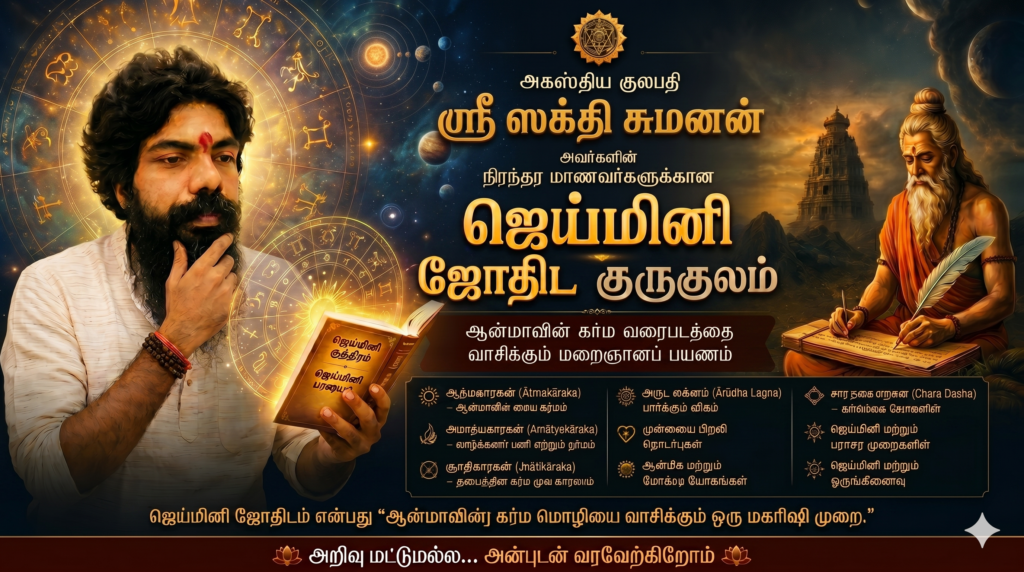
Jaimini Gurukulam – Lesson 02 Assessment
“`html
“`
Jaimini Gurukulam – Lesson 02 Assessment
Karmic Impressions, the Horoscope, and Self-Realization – MCQ Quiz
Jaimini Gurukulam – Lesson 02 Assessment Read More »
Karmic Impressions, the Horoscope, and Self-Realization – MCQ Quiz
Jaimini Gurukulam – Lesson 02 Assessment Read More »
The sages often compared the soul to a mirror.
The light of pure consciousness shines continuously, illuminating all existence.
However, a mirror covered with dust cannot reflect the sunlight.
Likewise, a soul obscured by karmic impressions fails to reflect its inherent luminosity.
When the dust is removed, the mirror naturally reveals its full capacity to reflect the sun.
Similarly, when karmic impressions are exhausted, the soul spontaneously recognizes its true nature as infinite consciousness and bliss.
Karma exists in two forms:
Most people believe that spiritual progress consists merely in accumulating puṇya.
Certainly, virtuous actions produce desirable experiences.
Good deeds may lead to wealth, knowledge, beauty, social respect, and material comfort.
Nevertheless, good karma is still karma.
Through countless births devoted exclusively to virtuous actions, one may attain future lives filled with luxury and happiness.
Yet one can remain ignorant of one’s true nature while living upon a heap of gold, just as easily as one can remain ignorant while living upon a heap of refuse.
Good karma merely replaces iron chains with chains of gold.
Liberation requires freedom from all chains.
The Vedic seers recognized that lasting happiness cannot be attained merely through favourable circumstances.
Even wealth and health are impermanent.
Prosperity eventually yields to old age.
Pleasure gives way to dissatisfaction.
Every birth culminates in death.
Consequently, the sages sought a solution that addresses the very root of bondage.
The solution they discovered was equanimity.
Karmic impressions give rise to emotional reactions.
These reactions, in turn, generate new impressions.
To interrupt this cycle, the sages recommended cultivating equanimity.
Equanimity is a state in which the mind remains undisturbed amidst pleasure and pain, success and failure, praise and blame.
As karmic impressions mature and experiences arise, one simply observes them without attachment or aversion.
In this state, old karmas are exhausted, while no new karmas are created.
The highest expression of equanimity is Samādhi.
Samādhi is complete absorption in pure consciousness, beyond all mental fluctuations.
Through deep meditation, profound inner stillness emerges.
This stillness accelerates the dissolution of karmic impressions.
On a practical level, equanimity may also be cultivated through philosophical reflection, self-observation, and the study of astrology.
Astrology helps individuals understand their life experiences within the framework of karmic law.
Meditation quietens the mind.
Astrology clarifies the patterns through which karma manifests.
Together, they become powerful instruments for liberation.
Vedic philosophy classifies karma into three categories.
Sañcita Karma is the total accumulation of karmas gathered throughout countless previous births.
It represents the complete karmic reservoir.
Prārabdha Karma is that portion of Sañcita Karma selected for experience in the present incarnation.
It is the karma reflected in the birth chart.
The natal horoscope functions as a map of Prārabdha Karma, revealing both the nature of karmic experiences and the periods during which they are likely to unfold.
Kriyamāṇa Karma consists of new karma generated through present choices and actions.
It represents human free will.
Life unfolds through the interaction between Prārabdha Karma and Kriyamāṇa Karma.
Prārabdha Karma manifests with varying degrees of intensity.
Mild karma does not overpower free will.
Individuals retain considerable freedom to shape their circumstances.
Moderate karma partially restricts free will.
Certain events become unavoidable, yet conscious effort can still influence outcomes.
Intense karma produces events that cannot easily be altered.
Under such circumstances, acceptance becomes the wisest response.
Most karmic tendencies observable in horoscopes belong to the mild or moderate categories.
Truly intense karma is comparatively rare.
People approach astrologers for many reasons.
Some seek entertainment.
Others desire predictions concerning wealth, relationships, or professional success.
Some wish to hear only pleasant forecasts and hesitate to discuss difficult periods.
Such attitudes reinforce attachment to pleasure and aversion to suffering.
Yet the highest purpose of astrology is self-understanding.
Astrology becomes a mirror through which one observes recurring tendencies, attachments, fears, and opportunities for growth.
When combined with meditation, astrology becomes a powerful discipline for spiritual transformation.
Meditation cultivates equanimity.
Astrology reveals the timetable through which particular karmic impressions are likely to manifest.
Together, they help individuals remain balanced amidst the inevitable fluctuations of life.
Paradoxically, when one ceases chasing pleasure and fleeing from suffering, life often becomes more harmonious.
At that point, the horoscope ceases to be merely an instrument for predicting the future and instead becomes a tool for self-realization.
It enhances free will, deepens inner peace, and facilitates the gradual dissolution of karmic bondage.
Finally, when all karmic impressions have been exhausted and no new impressions arise, the soul awakens to its true nature as infinite, luminous, and blissful consciousness.
Jaimini Lesson 02: Karma as the foundation of Jyotisa Read More »
The Law of Karma – MCQ Quiz
Jaimini Gurukulam – Lesson 01 Assessment Read More »
Jyotiṣa is far more than a system of divination. It is a profound vidyā—a spiritual science deeply rooted in an ancient philosophy of life. To understand Jyotiṣa properly, one must first understand the law of karma, for karma is the underlying mechanism upon which astrology rests. It is also the foundation of the Eastern understanding of spiritual evolution.
A proper understanding of karma provides the astrologer with a framework for explaining both the causes of suffering and, ultimately, the means by which suffering may be transcended.
Many people define karma through the familiar saying, “As you sow, so shall you reap.” While this statement offers a useful starting point, it fails to explain the intricate nature of karmic bondage and the process by which karmic impressions may be dissolved.
A superficial understanding of karma as merely a principle of cause and effect can easily lead to the mistaken belief that spiritual progress consists solely in performing good deeds and avoiding harmful actions. However, this does not represent the complete teaching.
Virtuous conduct undoubtedly produces beneficial results such as health, prosperity, favourable circumstances, and psychological well-being. Conversely, harmful actions generate suffering, illness, poverty, and various forms of distress. Ethical living is therefore both wise and necessary.
Nevertheless, virtuous conduct alone does not resolve the fundamental problem of karmic bondage. At best, it provides a means of obtaining a more pleasant existence in this world or in future births. To understand why, it is necessary to examine how karmic impressions arise, how they bind the soul, and how they may ultimately be removed.
The most fundamental spiritual principle is the existence of the Higher Self.
Ordinarily, human beings identify themselves with the body, mind, emotions, and ego. According to the Vedic seers, however, the true Self transcends all limitations. It is pure, unmanifest, and infinite consciousness.
The condition in which individuals mistakenly identify themselves with limited physical and psychological components, and consequently experience suffering, is called bondage.
Bondage arises because the soul becomes associated with karmic impressions accumulated through thoughts, words, and actions performed in the past.
Human individuality operates on several levels.
At the gross level exists the physical body.
At the subtle level exists the causal body, an invisible karmic vehicle that stores impressions created by past experiences, intentions, and actions.
Karmic bondage unfolds through three stages.
Individual consciousness continually generates emotions and desires such as anger, pride, deceit, attachment, and greed.
Each emotion possesses its own distinctive vibrational quality.
Whenever consciousness vibrates in a particular manner, it leaves an impression upon the causal body. This impression carries the same energetic signature as the mental state that produced it.
An action motivated by greed creates a karmic impression characterized by greed.
An action motivated by compassion creates an impression imbued with compassion.
The continual accumulation of such impressions is known as influx.
Once established within the causal body, an impression becomes a karmic bond.
Karmic impressions may broadly be divided into two categories:
Positive impressions generate pleasant experiences.
Negative impressions generate painful experiences.
From the standpoint of liberation, however, both are forms of bondage.
Whether one is bound by chains of iron or by chains of gold, bondage remains bondage.
As long as impressions remain stored within the causal body, the soul cannot fully realize its own infinite and blissful nature.
Every karmic impression possesses three characteristics:
Eventually, the lifespan of an impression comes to an end.
At that moment, it emerges from the causal body and manifests as an external experience corresponding to its original quality.
An impression created through greed may manifest as circumstances involving wealth, desire, loss, attachment, or possessiveness.
An impression created through generosity may appear as opportunities to give, occasions to receive assistance, or experiences of abundance.
The difficulty arises because people usually become emotionally entangled in these experiences.
When greed arises again during the fruition of karma, new impressions of greed are created.
When anger arises, new impressions of anger are formed.
Thus, what should have been the exhaustion of karma often becomes the creation of additional karma.
In this manner, beings become caught in an endless cycle of karmic bondage.
| Sanskrit Term | English Meaning |
|---|---|
| Karma | Action and its resulting impression |
| Bandha | Bondage |
| Ātman | The True Self |
| Puṇya | Meritorious karma |
| Pāpa | Unwholesome karma |
| Mokṣa | Liberation |
| Jyotiṣa | Vedic Astrology |
| Vidyā | Sacred Knowledge |
Jaimini Lesson 01: Karma as the Foundation of Jyotiṣa Read More »
You cannot copy content of this page